Ukraine Recovery Conference 2026 in Gdańsk — a guide for international firms
URC 2026 is not another international conference about Ukraine. It is the single most concentrated point of contact with the people, capital and institutions that will define Ukraine’s recovery for the next decade. Here is what international firms need to understand before attending.
Ukraine Recovery Conference 2025 in Rome generated 9.8 billion euros in new financial commitments. Approximately 200 agreements were signed totaling around 11 billion euros. Cumulative commitments across all five URCs since 2022 are estimated at around 200 billion dollars. These figures translate into specific projects, specific contracts and specific counterparties. The question is not whether international capital flows into Ukraine’s recovery — it already does. The question is which firms will be inside that flow.
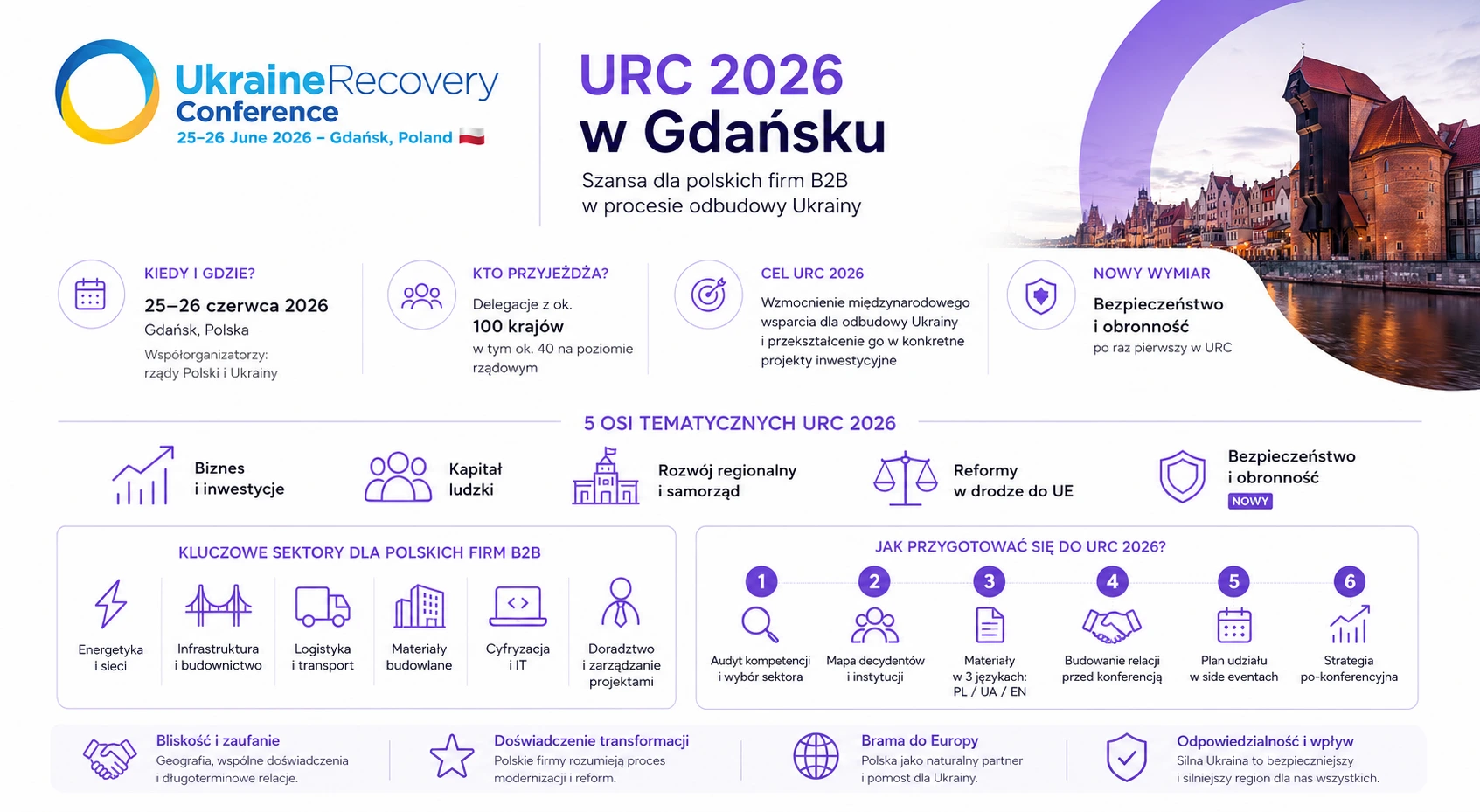
Ukraine Recovery Conference 2026 in Gdańsk — known as URC 2026 — is the most concentrated business event for Ukraine’s recovery in the calendar this year. For international firms considering Ukraine engagement, the conference is not a networking opportunity in any conventional sense. It is the platform where strategic positions are taken, partnerships are formed, and decisions about who participates in one of Europe’s largest investment processes of the coming decade are made.
At the nech we work daily with B2B companies entering Polish and Ukrainian markets — including international firms using Poland as an operational platform for Ukraine engagement. From that practice we have built a specific view of what URC 2026 means in real terms, what to expect on the ground in Gdańsk, and — most importantly — how to prepare so the two days deliver a result.
A short history of Ukraine Recovery Conference
Understanding what to expect from URC 2026 starts with understanding how the format has evolved since 2022. Each edition has had a different character and a different result — but together they have built what is today the most serious international platform coordinating support for Ukraine’s recovery.
First edition — principles and priorities
Five months after the full-scale Russian invasion, the Lugano conference defined the methods, priorities and principles of the recovery process. This was primarily a political and programmatic declaration.
Ukraine Facility — €50 billion from the EU
The European Commission announced a €50 billion package under Ukraine Facility — a multi-year financing instrument for recovery. London was the moment when international support moved from declaration into concrete mechanisms.
Four dimensions and the private sector
Berlin formalized the program around four dimensions: business, human capital, regional development and EU reforms. For the first time, the private sector received explicit, structured space in the conference program.
Record-scale commitments
URC 2025 generated 9.8 billion euros in new financial commitments, around 200 signed agreements worth approximately 11 billion euros. The Coalition for Ukraine’s Recovery and European Flagship Fund were launched. Over 6,000 participants from approximately 70 countries — the strongest private-sector presence in the history of the format.
A fifth dimension — security and defense
URC 2026 is the first edition hosted in Central and Eastern Europe. Poland introduced a new fifth dimension — security and defense — arguing that without security there is no sustainable recovery. This opens defense industrial cooperation and dual-use technology as a new track at the conference.
Two conclusions emerge from this evolution. First, the format is maturing. From a declarative forum, URC has become a transactional platform. Second, the role of the private sector grows with each edition. Rome 2025 had the strongest business participation in the history of the conference, and Gdańsk 2026 is expected to extend that trajectory further.
Why should an international firm attend Ukraine Recovery Conference 2026?
An international firm with no specific exposure to Ukraine may reasonably ask why URC 2026 deserves senior management time and travel budget. Four arguments stand up to scrutiny.
Concentration of decision-makers
Roughly 40 governments at the political level, dozens of international financial institutions, the leadership of major Ukrainian agencies, and several thousand corporate executives will all be in one city for two days. Replicating this density through bilateral travel would take months and a significantly larger budget. For a firm at the strategy-formation stage, URC compresses what would otherwise be a multi-quarter market discovery process.
Scale of the recovery economy
World Bank and Ukrainian government estimates put the total cost of Ukraine’s infrastructure recovery above 500 billion dollars. This is not a window opening for a season — it is a new, long-term market in the EU’s immediate neighborhood. Firms that build positions during the formative phase (2024–2027) will be structurally advantaged for the deployment phase (2027–2034).
Geopolitical signal
URC 2026 in Gdańsk is the most visible signal to date that the Western political establishment treats Ukraine’s recovery as a strategic priority, not a temporary humanitarian commitment. For firms with longer-cycle decisions — capital allocation, joint venture structuring, regulatory positioning — this signal matters more than the specific deal flow generated at the event itself.
EU accession trajectory
Ukraine’s EU accession process is advancing in parallel with the recovery. For sectors where EU regulatory frameworks define the market — energy, telecommunications, financial services, agriculture, transport — URC 2026 is the venue where the regulatory trajectory becomes most legible.
Poland as the operational base for Ukraine engagement
One question that comes up consistently in our work with international clients is: should we approach Ukraine directly, or through a Polish partner? Our answer, for the great majority of cases over the first 24–36 months of engagement, is through Poland. The argument is structural, not preferential.
Geographic and infrastructure proximity
Poland is the only major Western jurisdiction with a 500+ kilometer land border with Ukraine. Travel time from Warsaw to Kyiv is shorter than to most operational sites within Ukraine itself. Polish ports, road and rail infrastructure are the primary logistics corridor between Ukraine and the rest of the EU. For any sector where supply chains, project execution or staff mobility matter, this changes economics meaningfully.
EU member-state framework
Poland is a full EU member with twenty years of integration experience. A Polish subsidiary, Polish project entity, or Polish joint venture brings the international firm under EU regulatory and contracting frameworks. This matters in three concrete ways: EU procurement eligibility, EU funding access, and EU-grade legal predictability for cross-border arrangements.
Cultural and operational fluency
Polish business culture has deep familiarity with both Western corporate practices and Eastern European operational realities. Polish management teams can interface with international headquarters using global standards and with Ukrainian counterparties using regional understanding. This translation function is genuinely difficult to replicate by other means.
Existing Polish-Ukrainian business ecosystem
Tens of thousands of Ukrainian businesses already operate in Poland, and Polish-Ukrainian commercial relationships pre-date the war by decades. The legal, advisory, banking and recruitment infrastructure for working across this corridor is mature. International firms entering through Poland inherit this ecosystem rather than building one from scratch.
This is not an argument against direct Ukrainian engagement in principle. It is an argument about where to begin. Direct entry typically makes sense once the firm has built sufficient local infrastructure, counterparty knowledge and regulatory familiarity to operate without an intermediary base — usually three to four years into the engagement.
The five thematic axes of URC 2026 through an international firm lens
The Ukraine Recovery Conference 2026 program is organized around five thematic axes. Each opens different categories of opportunity for international firms.
1. Business and investment
The primary axis for the private sector: public-private partnerships, investment instruments, risk insurance, supply chains. The most concrete sector-specific side events sit here. For international firms, this is the first point of focus.
2. Human capital
Workforce mobility, veteran reintegration, vocational training, labor markets. For firms with significant Ukrainian workforce exposure — IT services, manufacturing, agribusiness — this axis offers concrete partnership pathways with Ukrainian institutions and EU mobility programs.
3. Regional development and local governance
City and regional partnerships, local government financing, municipal infrastructure. International firms serving the public sector — engineering, smart city, urban infrastructure — find their natural counterparties here.
4. EU reforms
Harmonization of Ukrainian law with the EU acquis communautaire, institutional reforms, regulatory alignment. Law firms, regulatory consultancies, audit and compliance specialists encounter direct demand for accession-related expertise. International firms with EU regulatory depth have a distinct advantage in this stream.
5. Security and defense (new dimension)
Introduced for the first time in Gdańsk, this axis covers defense industrial cooperation, critical infrastructure protection, cybersecurity and dual-use technology. For international defense and security firms, this is a new and rapidly developing track that did not exist at previous URC editions.
Sectors where international capital meets Ukrainian capability
Beyond the formal program, certain sectors stand out in 2026 for the combination of international capital interest and Ukrainian operational capacity. These are where transactions are most likely to crystallize over the 12–24 months following URC 2026.
Distributed generation, transformers, storage, renewables, grid hardening. Combines EU climate funding, Ukrainian site need and mature international technology offerings.
Roads, rail, bridges, water systems, district heating. Project finance from EBRD, EIB, IFC and bilateral DFIs is structured here, with Polish and international engineering firms as natural lead contractors.
Integration of Ukrainian transport networks with the Trans-European Transport Network. Operators, terminal builders, customs technology and supply-chain integrators have concrete opportunities.
Ukraine has an internationally recognized cybersecurity and software engineering capability. International firms partnering with Ukrainian teams gain technical depth at competitive rates with strong reputation.
The new security dimension in URC 2026 opens defense industrial cooperation — drones, communications, sensor technology, critical infrastructure protection.
Prefabricated construction, concrete, steel, insulation, modular systems. Geographic proximity matters — transport cost from Poland or Ukraine itself decisively beats Western European suppliers.
Design, project management, audit and compliance for EU-financed projects. International engineering firms with Polish or Ukrainian operating partners are the natural prime contractors.
Trade finance, political risk insurance, project finance arrangement, export credit. The architecture being built around Ukraine’s recovery requires specialized financial intermediation at every layer.
90-day preparation plan for international firms
From our practice with international clients preparing for major regional events, one pattern is consistent. Firms that prepare systematically over 90 days return from URC with three to four real follow-up conversations. Firms that prepare in the last two weeks return with business cards they will not use.
Strategic positioning across the five URC axes
Honest internal assessment: which of the five thematic axes does the firm credibly fit? What is the specific value proposition for Ukrainian or Polish counterparties? Generic “we have global experience” does not work at URC — specific “we built three grid-scale solar projects in adjacent markets” does.
Polish partner identification
Before URC, identify two to three potential Polish operating partners or anchor relationships. These need not be exclusive partnerships — the goal is to attend Gdańsk having already opened conversations rather than starting from cold. Polish-Ukrainian Chamber of Commerce and sector-specific Polish associations are useful entry points.
Ukrainian counterparty pre-screening
For each sector of focus, build a shortlist of relevant Ukrainian counterparties — both private and public sector. Run preliminary due diligence on the top names so URC conversations can move beyond introductions into substance. This requires either internal capability or a local advisor with practical screening experience.
Preliminary meetings before the conference
Initiate 15-minute online conversations with five to ten priority contacts before URC. The goal is not to close anything — it is to convert URC meeting time from cold introductions into structured follow-up. This single step separates well-prepared delegations from the rest.
Conference calendar and side events
Specific calendar of meetings in Gdańsk. The highest-value conversations typically happen at sector-specific side events organized by chambers, funds and embassies — not on the main stage. A firm spending two full days in the plenary hall captures perhaps 20% of the real value of the conference.
Follow-up system ready before departure
CRM, email templates in English and Polish, sequenced outreach plan for the first 14, 30 and 60 days after the conference. URC contacts have a temperature half-life of about two weeks — without a ready follow-up system, the most expensive line item in conference attendance becomes the lost opportunity.
Common mistakes international firms make at Ukraine Recovery Conference
Across multiple URC editions and similar regional events, certain patterns of failure repeat. Most of them are unforced and entirely preventable with preparation.
The parachute approach
Senior executives fly in, expect deals to materialize from prepared speeches, and fly out. URC does not function this way. Real relationships are built before the conference, deepened in Gdańsk, and converted in the following 12–24 months. The parachute approach is the most expensive way to produce no result.
Bypassing regional partners
Some international firms believe they can move faster by approaching Ukrainian counterparties directly, treating Polish partnerships as an unnecessary intermediation cost. This is a common error. The Polish ecosystem typically saves more time, capital and risk in the first 24 months than it costs.
Wrong delegation composition
Two failure modes. Delegations that are too senior — only executives, no operating leads, no local-language capacity — cannot convert meetings into operational follow-up. Delegations that are too junior — analysts and middle managers without decision authority — cannot close anything beyond introductions. The right delegation has both layers.
Insufficient cultural and language preparation
English is the conference working language, but a meaningful portion of the highest-value conversations happen in Polish or Ukrainian — particularly at side events and informal gatherings. International firms without at least one team member with regional language and cultural fluency systematically underperform delegations that have this capability.
Treating URC as a transactional event
URC is a relationship platform, not a deal floor. Firms that arrive expecting to sign agreements at the conference itself misunderstand the format. The signed agreements at URC are typically the visible step in deal processes that started months earlier — at the previous URC, at sector events between conferences, or through bilateral channels.
Underestimating compliance and regulatory complexity
Operating in Ukraine, even through Polish intermediaries, requires careful navigation of EU sanctions architecture, AML/KYC frameworks, customs procedures and sector-specific regulation. Firms that have not done preliminary regulatory work arrive at URC unable to commit on terms because the underlying framework questions remain open.
No follow-up system
The most universal and most expensive mistake. URC contacts retain meaningful conversion potential for roughly two weeks after the event. Without prepared CRM infrastructure and outreach sequences ready before departure, perhaps 80% of meaningful contacts simply lose temperature and are never converted.
The long view — Ukraine recovery as a decade-long process
URC 2026 is a single point in a long cycle. The realistic timeline from a first contact at the conference to a closed major contract or financing round is typically 12–24 months. Firms that used URC 2025 in Rome effectively are only now, in 2026, seeing the first concrete results. This is normal pacing for serious investment and partnership decisions in a complex jurisdiction.
On the other hand, the scale of the recovery process is such that opportunities will continue to open throughout the coming decade. Reconstruction at the projected scale — north of 500 billion dollars across infrastructure, energy, housing, industrial capacity and public services — is structurally a multi-decade undertaking. Firms that build positions during the formative phase enter the deployment phase as established participants rather than late arrivals.
From an international firm perspective, the most important strategic question is not whether to engage with Ukraine’s recovery — it is how to structure that engagement so it compounds over time. The answer for most firms involves a Polish operational base, a deliberate counterparty strategy in Ukraine itself, and a long-cycle view of relationship building. URC 2026 in Gdańsk is one of the highest-leverage points in that strategy. It deserves preparation matched to its weight.
Preparing for URC 2026?
We help international firms structure their engagement with Ukraine’s recovery through Polish operational bases — from strategic positioning to specific meeting preparation in Gdańsk. The first consultation is complimentary.
Book a consultation →Frequently asked questions about Ukraine Recovery Conference 2026
When and where will Ukraine Recovery Conference 2026 take place?
Ukraine Recovery Conference 2026 will take place on 25–26 June 2026 in Gdańsk, Poland. The conference is co-hosted by the governments of Poland and Ukraine, with coordination on the Polish side led by a committee under the Minister of Finance and Economy.
Why should an international firm attend Ukraine Recovery Conference 2026?
URC 2026 is the most concentrated point of access to decision-makers across Ukrainian government, international financial institutions, donor agencies, and Ukrainian private sector. For international firms considering Ukraine engagement, two days at URC delivers more relationship density than months of bilateral travel.
How is URC 2026 different from previous editions in Lugano, London, Berlin and Rome?
URC 2026 is the first edition hosted in Central and Eastern Europe. The new element is a fifth thematic dimension — security and defense — introduced by Poland. The other four dimensions (business, human capital, regional development, EU reforms) continue from Berlin 2024 and Rome 2025.
Why does Poland matter so much for international firms working on Ukraine recovery?
Poland is the operational base from which most international engagement with Ukraine practically flows. Geographic proximity, EU membership, cultural fluency, and the existing Polish-Ukrainian business infrastructure make Poland the most efficient regional platform for international firms entering Ukraine. Direct entry without Polish presence is possible but typically slower and more expensive.
What is the realistic timeline from URC 2026 to a signed deal in Ukraine?
The realistic timeline from first conference contact to a signed major contract or financing closing is typically 12–24 months. URC 2026 is the point where relationships are built and partners identified, not where finished agreements are signed. Firms that treated URC 2025 in Rome as a starting point are only now seeing first concrete results in 2026.
Which sectors are most relevant for international firms at URC 2026?
Energy and grid infrastructure, critical infrastructure PPPs, logistics and TEN-T integration, IT and cybersecurity, defense and dual-use technology, construction materials and prefabrication, engineering and project management, and financial services including risk insurance and trade finance.
Should an international firm work through a Polish partner or enter Ukraine directly?
In most cases, working through a Polish partner is faster, cheaper and lower-risk for the first 24–36 months of engagement. Direct entry makes sense once a firm has built sufficient local infrastructure and counterparty knowledge. For most international firms attending their first URC, the Polish partnership route is the right starting point.
How much was committed at the previous Ukraine Recovery Conference?
URC 2025 in Rome generated 9.8 billion euros in new financial commitments. Approximately 200 agreements and memoranda were signed totaling around 11 billion euros. Cumulative commitments across all five URCs since 2022 are estimated at around 200 billion dollars.