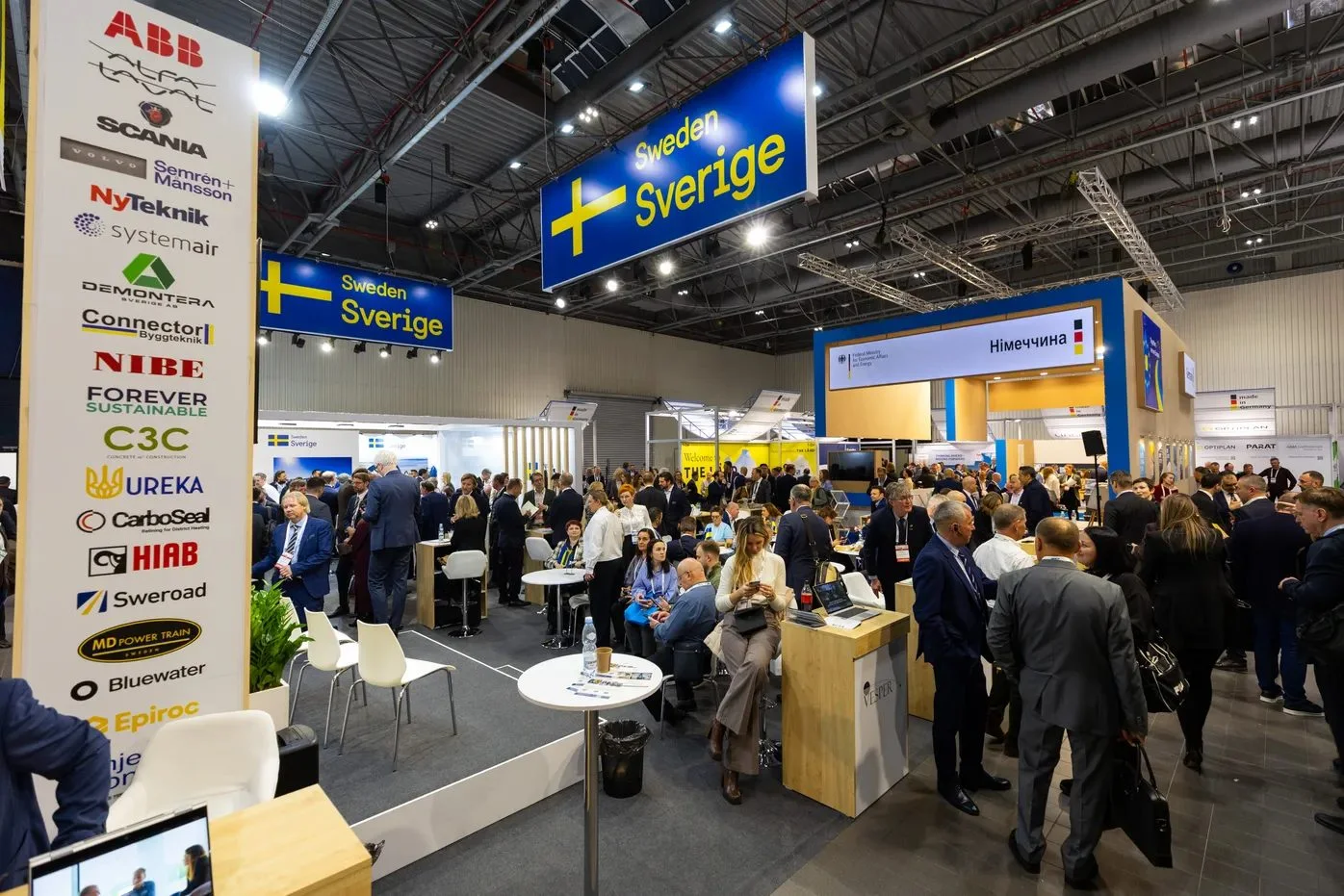
Cooperate Together 2026: why Poland is the gateway to Ukraine and the EU
On 11 June 2026, Kyiv hosts Cooperate Together 2026 (full name: Europe-Poland-Ukraine: Cooperate Together'26), a conference organised by the Union of Entrepreneurs and Employers of Poland (ZPP). For many international companies, Ukraine's reconstruction still reads as risk, distance and uncertainty. For others it is already a clear growth direction. The difference between the two rarely comes down to courage. It comes down to preparation.
In this article we explain what actually sits behind the talk of Ukraine's EU integration and the Ukraine Facility, and why Poland is the natural base for companies that want exposure to both the EU single market and Ukraine's recovery. We write from a practical standpoint, because we work in Poland and Ukraine at the same time.
What is the Cooperate Together 2026 conference?
Cooperate Together is a flagship programme run by the Union of Entrepreneurs and Employers of Poland since 2022. Its goal is to build durable, effective relationships between the business communities of Europe, Poland and Ukraine in the context of Ukraine's economic recovery.
This year's edition focuses on economic and institutional cooperation tied to Ukraine's EU integration and to projects under the Ukraine Facility. The programme features panels on Ukraine in the EU single market, infrastructure challenges, reconstruction financed with EU funds, and cooperation in the energy sector. Speakers include representatives of government, financial institutions and large companies operating on both sides of the border.
For a firm like ours this is not an event about politics. It is a map of where money and contracts are actually moving. That is how it is worth reading.
Why does Ukraine's EU integration matter for international business?
Accession is not only symbolic. It is the gradual alignment of Ukrainian law, norms and standards with those of the European Union. For a business that means one concrete thing: the market becomes more predictable. And predictability is the currency most expansion decisions lack.
As Ukraine moves closer to EU rules, it becomes easier to plan supply, sign contracts and build value chains that connect Ukraine, Poland and the wider EU. For an international company this turns a fragmented region into a single, more coherent opportunity. The companies that position early tend to set the terms later.
The winners are not the ones who move fastest, but the ones who arrive best prepared.
What is the Ukraine Facility, and where does private business fit in?
The Ukraine Facility is a multi-year European Union financial instrument for 2024 to 2027. According to the European Commission and the Council of the EU, its total value is up to 50 billion euro, made up of 33 billion in loans and 17 billion in grants. The instrument supports macroeconomic stability, recovery and modernisation, and reforms on Ukraine's path to EU membership. By April 2026, more than 36 billion euro had been drawn from it.
From a business standpoint the most relevant part is not the state-support budget, but the Ukraine Investment Framework: an investment structure equipped with around 9.5 billion euro in guarantees and grants that, by the European Commission's estimate, is expected to mobilise up to 40 billion euro in public and private investment. This is where the space for private business opens: guarantees that lower investment risk, and a blend of public and private financing that makes projects in Ukraine more accessible.
International companies rarely tap these funds directly, since they flow to the Ukrainian side. They benefit indirectly: by delivering contracts, materials, technology and services tied to reconstruction, and by joining projects covered by EU guarantees. That changes the risk calculation.
Which sectors hold the biggest opportunity?
Reconstruction sounds broad, but very specific industries sit behind it. From our experience on both markets, a few stand out with real, existing demand:
- Infrastructure and construction. Roads, bridges, public facilities and housing are the backbone of reconstruction, and they draw in suppliers, contractors and engineering firms.
- Energy, including renewables. Rebuilding a resilient, distributed energy system is a priority. This is an area where we have direct project experience.
- Logistics and supply chains. Transport, warehousing and distribution have to keep pace with the scale of reconstruction projects.
- Professional services. Advisory, design, project management and regulatory compliance are needed at every stage.
The common thread is that the demand is not hypothetical. It rests on concrete programmes and budgets, not on forecasts for some time after the war.
Why use Poland as your base for Ukraine and the EU?
For most international companies, the practical question is not only whether to engage with the region, but how to do it from a stable base. Poland is the obvious answer.
- An EU member state with full access to the single market of roughly 450 million consumers.
- A direct border and the largest trade corridor with Ukraine, with established logistics in both directions.
- A large Ukrainian community and dense business and human ties between the two countries.
- A mature legal and banking environment, with operating costs below most of Western Europe.
In practice, many companies set up or expand a Polish entity first, use it to serve the EU market, and treat it as the operational bridge to Ukraine. That sequencing reduces risk and keeps options open. Helping companies do exactly that is one of our core areas: see our work on Polish market entry and market expansion strategy.
How to prepare to enter the region
Entering an early-stage market follows the same rules as any expansion, only the stakes and the pace are higher. Order matters.
- Market and segment analysis. First we answer where the demand for the product or service sits, who pays for it and what the competition looks like. Without that, everything else is guesswork.
- Entry strategy. Export, local representative, entity or partnership: each model carries a different risk and cost. The choice depends on the sector and the time horizon.
- A credible local partner. On a new market, a good partner saves months and lowers the risk of mistakes.
- Financing and guarantees. It is worth checking whether a project can use EU guarantee instruments that lower investment risk.
- Compliance and risk management. Standards, permits, settlement and security should be planned upfront, not handled reactively.
We help companies move through this in sequence: from business strategy and market analysis, through the right entry model, to building sales once you are in. The gap between a plan on paper and execution is, for us, the whole point of the work.
What risks should you weigh?
An honest conversation about opportunity needs an equally honest conversation about risk. The region is not a closed market, but it is an early one. Those are different things.
Four things you cannot ignore
Security and continuity. The situation changes over time. An entry model should let you act in stages, without committing large resources to a single point at once.
A regulatory environment in transition. Law shifts alongside the accession process. That is a chance for predictability, but in the transitional period it calls for close attention to change.
Settlement and currency. Payment terms, securities and currency exposure should be agreed at the start, not negotiated after the fact.
Partner selection. The biggest risk on a new market is the wrong partner. Verifying registration data, project history and real operational presence is non-negotiable.
None of these risks cancels the opportunity. Each can be built into strategy and contract. The trouble starts only when a company enters without a plan and treats risk as a problem for later.
Where to start?
Cooperate Together 2026 is a good vantage point: it shows who is building cooperation between Ukraine, Poland and the EU, and around which projects. But attending a conference is only an impulse. The decision on whether and how to enter should rest on analysis, not on post-event enthusiasm.
If you are weighing this direction, start with a simple question: where exactly is the demand for what your company offers, and what is good preparation worth against the cost of a rushed entry. That question is where we begin every expansion project.
Considering Poland, the EU or Ukraine as your next market?
Let's talk about your company's situation and where the real opportunities are.
Book a consultationFrequently asked questions
Is it worth entering the Ukrainian market during the war?
It depends on the sector and the entry model. Parts of the market, such as construction, energy and professional services, already show real demand tied to reconstruction. What matters is managing risk deliberately and choosing a form of presence that lets you act in stages, without committing large resources at once.
Can an international company benefit from the Ukraine Facility?
Companies do not receive Ukraine Facility funds directly, since they go to the Ukrainian side. They benefit indirectly: by delivering contracts financed from these funds and by joining projects under the Ukraine Investment Framework, which lowers investment risk through guarantees and a blend of public and private financing.
Why use Poland as a base for the region?
Poland is an EU member with full single-market access, the largest trade corridor with Ukraine, strong business ties and a mature legal and banking environment. For many international companies it is the most natural base from which to serve the EU and operate towards Ukraine.
Where should we start when entering Poland or the EU?
With analysis: where the demand for your product or service sits, who pays for it and what the competition looks like. Only then does it make sense to choose an entry model, a partner and a financing path. Strategy comes before action, because on a new market a mistake costs more.