The credibility triangle: how a B2B buyer checks you before you ever speak
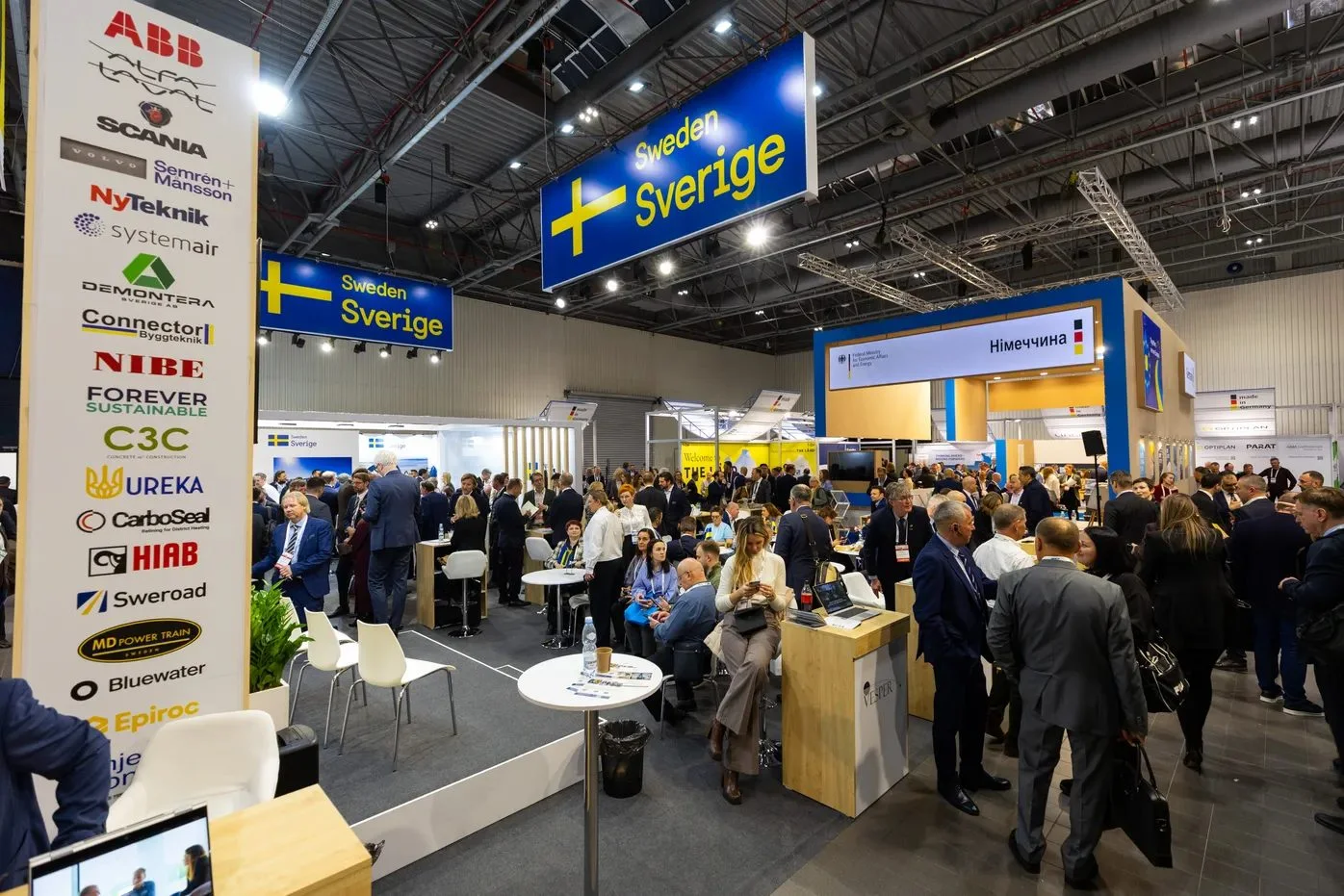
You met at a trade show, at a conference, or on LinkedIn. The other person said the topic was interesting. Then something happens that you never see and can no longer influence: they go and check you. B2B credibility is decided in those 15 minutes, while you are still walking back to your stand.
We work with companies that sell complex products and services to other companies: equipment manufacturers, engineering firms, general contractors, component suppliers. The markets vary: Poland, Ukraine, the European Union, North America, the Middle East. The problem repeats almost word for word.
A strong company with real production, good technology and a full order book at home goes abroad and cannot understand why the foreign partner who was so enthusiastic at the trade show then goes quiet for months. The reason is usually not price and not the product. The reason is that B2B credibility gets verified online, and online this company barely exists.
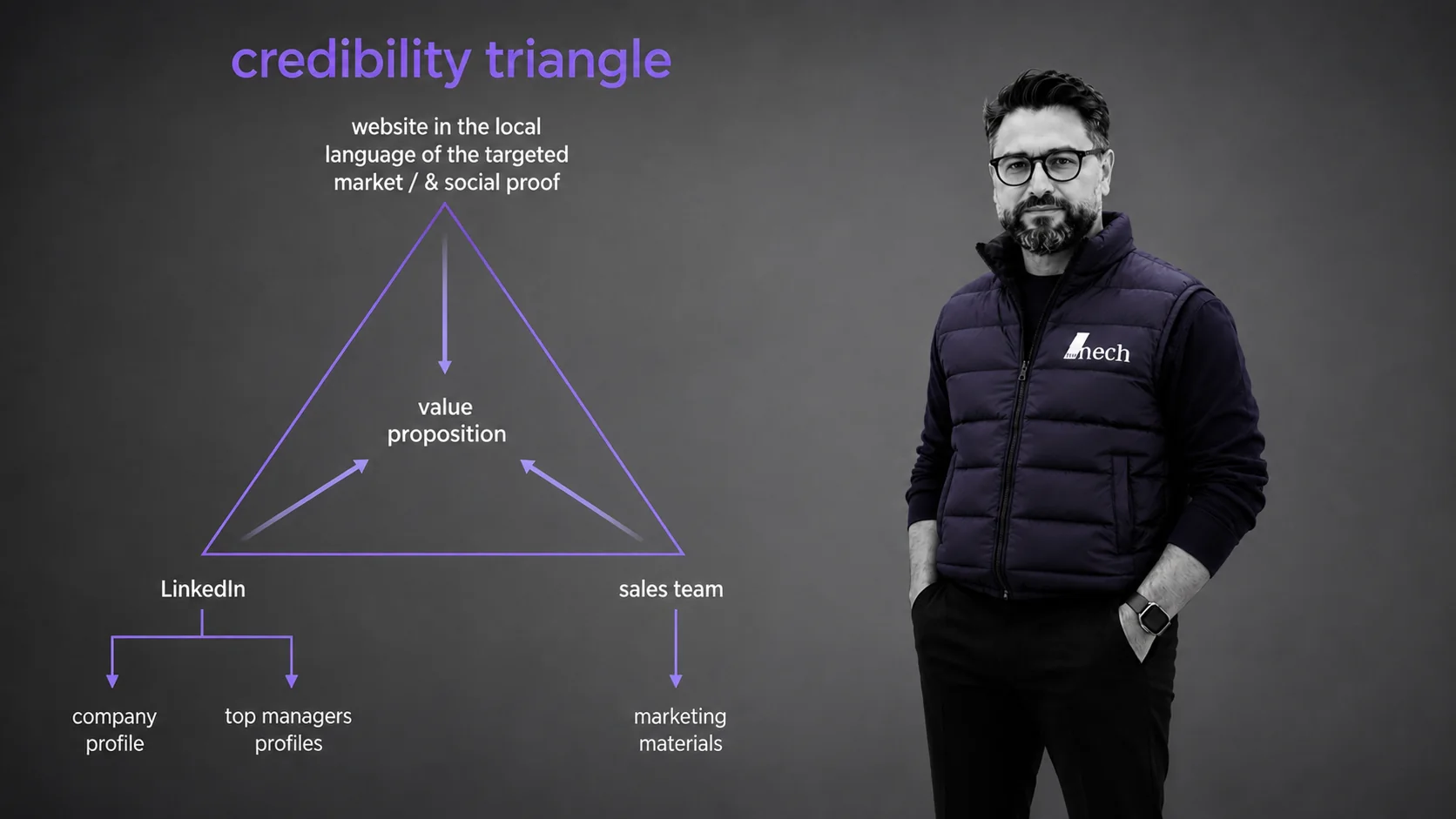
So that we do not have to explain this from scratch every time, we put together a simple tool and call it the credibility triangle. Three pillars the buyer checks, and three places where everything can be undone even with the best product in the segment.
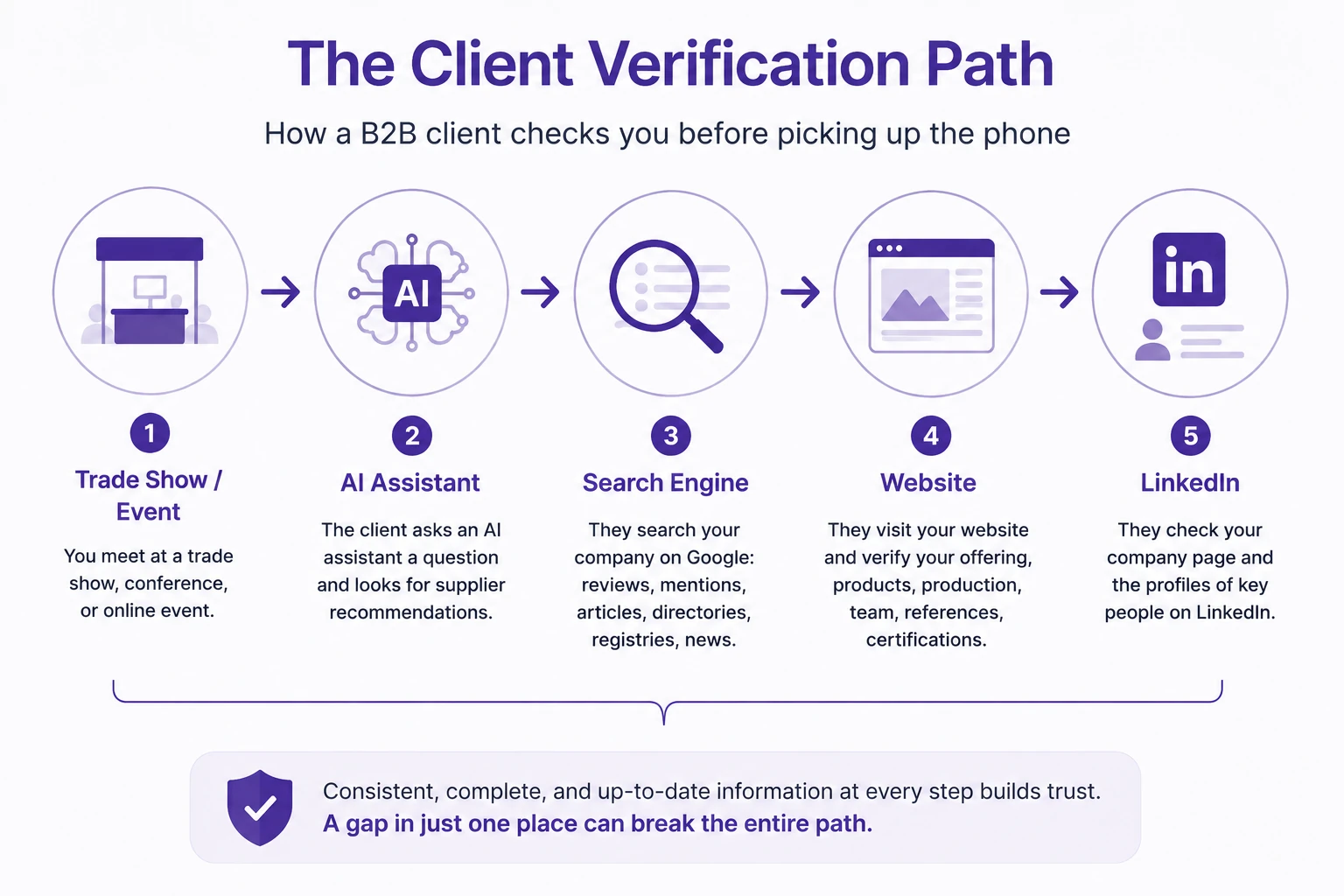
What happens after you exchange business cards?
The prospect goes to check you online, and does it without you in the room. Gartner surveyed 632 B2B buyers: 61% prefer a buying experience with no sales rep at all. Your website and your LinkedIn work in your place at that moment, and there is nothing you can tell them.
Five years ago verification meant Google. Today the first step increasingly happens in ChatGPT, Claude, Gemini or Perplexity. A Semrush survey of 519 US B2B professionals, run in March and April 2026, found that 66% regularly use AI to research vendors and another 29% do it occasionally. That is almost everyone.
The most useful part of that survey is not AI usage itself but what people do next. Once AI names a vendor, 71% go to that vendor’s website, 63% search the company name on Google, and 38% check reviews on industry platforms. AI does not replace verification, it accelerates it and becomes the first filter. 92% of respondents said AI shaped their shortlist.
That produces a simple mechanic worth accepting without resistance: if little is written about your company online, or it is written only in your own language, AI has nothing to build an answer from. It will not say “insufficient data”. It will simply talk about your competitors.
How is B2B credibility actually built?
B2B credibility is assembled from three sources a buyer checks before the first call: the website together with external mentions, the LinkedIn presence of the company and its top managers, and the sales team together with its marketing materials. We call this the credibility triangle. The pillars only work together: a weak third one cancels out two strong ones.
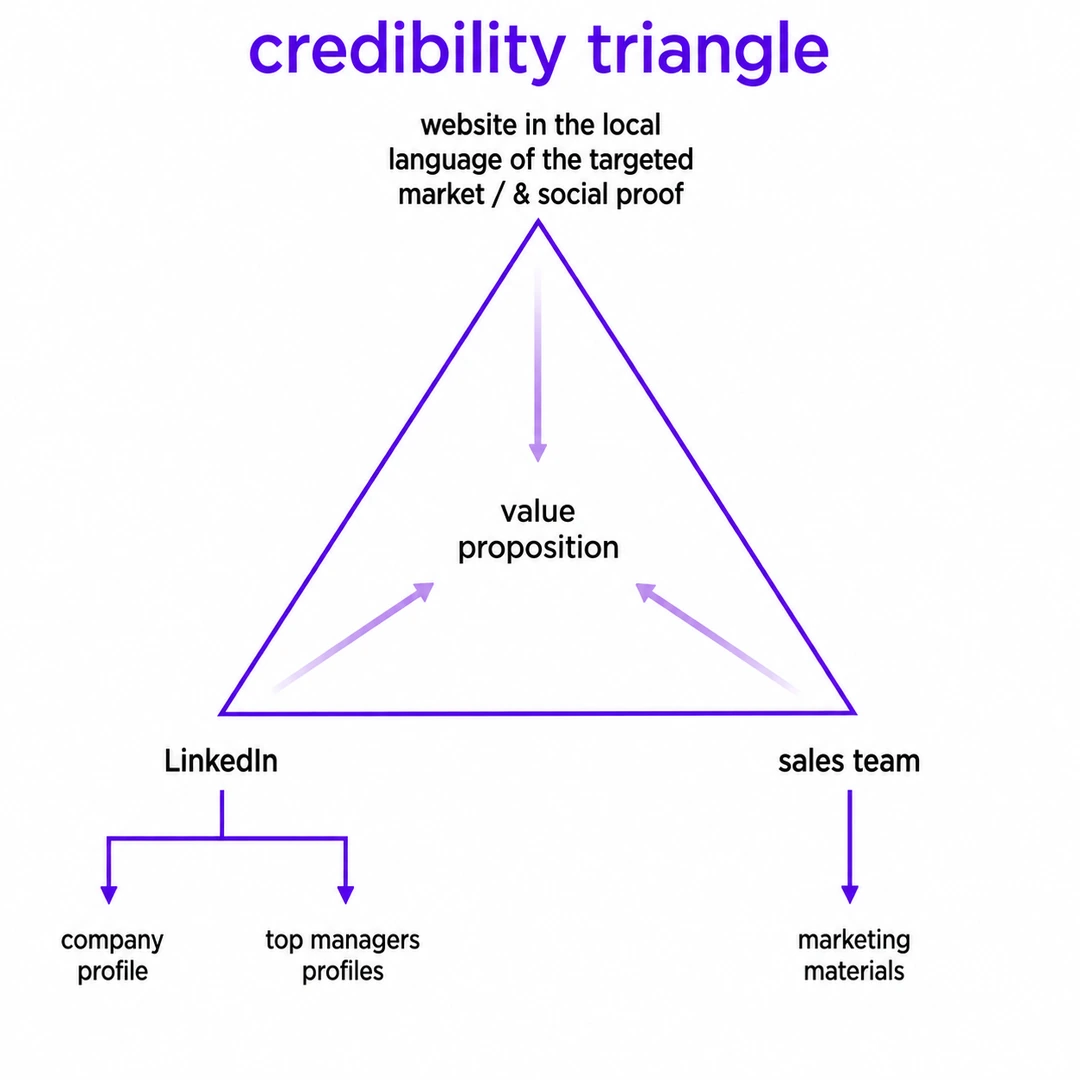
| Pillar | What the buyer is really checking | Typical failure |
|---|---|---|
| Website + social proof | Whether the company physically exists, and has the production and the scale you described in person | No proper version in the target market’s language, no shop floor photos, no plant address |
| LinkedIn, company and people | How many people work there, whether the company is growing, who decides and how they speak in public | Empty page, 5 linked employees, last post two years old |
| Sales and materials | Whether everyone in the company says the same thing, whether the catalogue matches the website | A deck with different positioning, a free mailbox in the signature |
The most telling number from the same Gartner study: 69% of B2B buyers run into inconsistencies between what the vendor’s website says and what the seller tells them. This is not a detail. The buyer does not conclude “marketing has not updated the file yet”. The buyer concludes “these people do not understand their own offer”.
Does your website confirm what you say about yourself?
The website has to confirm every claim you made in person. You said “we have our own production”, so the site needs shop floor photos, floor area, machinery, the city. You said “a large team”, so the people have to be visible. Positioning without evidence reads as advertising, not as a fact about the company.
We put it to clients like this: your website is not a brochure, it is a verification document. The visitor did not come to be inspired, they came to check what they heard against what they see. Every mismatch costs you credibility, every match adds to it.
Production: photographs, not renders
If your advantage is your own production, the site needs real shots of the shop floor, the line, the warehouse, the finished product in its packaging. Not stock photos of abstract robots. Not 3D renders. Real photographs with captions: which section, which machinery, what output. Add numbers: floor area in square metres, year of commissioning, monthly capacity, number of shifts. Numbers make a page quotable, both for people and for AI.
People: who actually works there
If you talk about a strong team, show it. The minimum is a leadership block: name, role, photograph, short bio, LinkedIn link. In B2B this works better than any slogan, because the buyer does not buy from “a company”, they buy from the specific people they will be talking to.
If you are on the management board and do not want to publish a personal address, that is fine. Give a general departmental address or a contact form. What matters is not the address itself but the existence of a short, obvious path to a live human being.
Contact details: an obvious path to a conversation
Legal name, address, registration details, working languages, markets served. For a foreign buyer this is not bureaucracy, it is basic verification: is there anyone to invoice, and does this legal entity exist at all. A European purchaser will very likely open the national register and check the name. Make checking easy.
Why does a manufacturer need a full site in the buyer’s language?
A website in your target market’s language is not a translation, it is a separate asset for a separate audience. Without it, the foreign buyer and the AI assistant have no source of information about you. Browser auto-translation does not help: it never touches PDF catalogues, captions inside diagrams, or item names in the price list.
We regularly meet modern companies with real export potential whose English page consists of three paragraphs and a form. Sometimes there is no English page at all. The same company travels to international trade shows and spends tens of thousands of euros on a stand for four days.
The arithmetic here is brutal. The stand gives you a contact. The website decides whether that contact becomes a conversation. If after the show someone opens your site and sees a language they cannot read, they will not go looking for a translator. They will go back to the stack of business cards and pick the next one.
A CSA Research study of 8,709 consumers across 29 countries found that 76% prefer to buy when the information is in their own language. That is consumer data and it cannot be transferred to industrial procurement one to one. But it points honestly in one direction: an unreadable language is a barrier, not a detail.
The minimum scope for the language version: company description, production with photographs, products or services with technical parameters, certificates, case studies, team, contact. This is not a translation of the homepage. It is a separate block of work, and it belongs in the budget for entering the market. We write more about export preparation on our page about market expansion strategy.
What is social proof and who creates it?
Social proof is everything written about you by someone other than you: trade media, exhibitor catalogues, registers, partner publications, client references, mentions by associations. Your own website says who you would like to appear to be. Third parties confirm who you actually are. Credibility is built on that second source, and that is the one most often missing.
The checker’s logic is simple. They open your website and see claims. Then they type the company name into a search engine and look at whether this company exists outside its own site. If the first page of results is your site, your LinkedIn and one more aggregator with an empty card, the company looks fragile even if it is 20 years old.
What actually builds social proof in industrial B2B:
- Exhibitor profiles on the websites of the trade shows you attended, with the description and product range filled in
- Membership in industry associations and chambers of commerce, including bilateral ones
- Articles and expert comments in your own industry’s publications, not in general business media
- Certificates and standards with numbers and years, not logos in the footer
- Case studies told from the client’s side: when the customer describes the project, it is worth more than your own account
- A Google Business Profile with photographs, categories and reviews
There is a non-obvious point here that changes priorities considerably. For being cited in AI answers, unlinked brand mentions correlate with visibility more strongly than classic backlinks. Put simply: when people write about you it works, even if they did not add a link. A mentions campaign is cheaper than a link campaign and in 2026 it delivers more.
What should a company LinkedIn page look like?
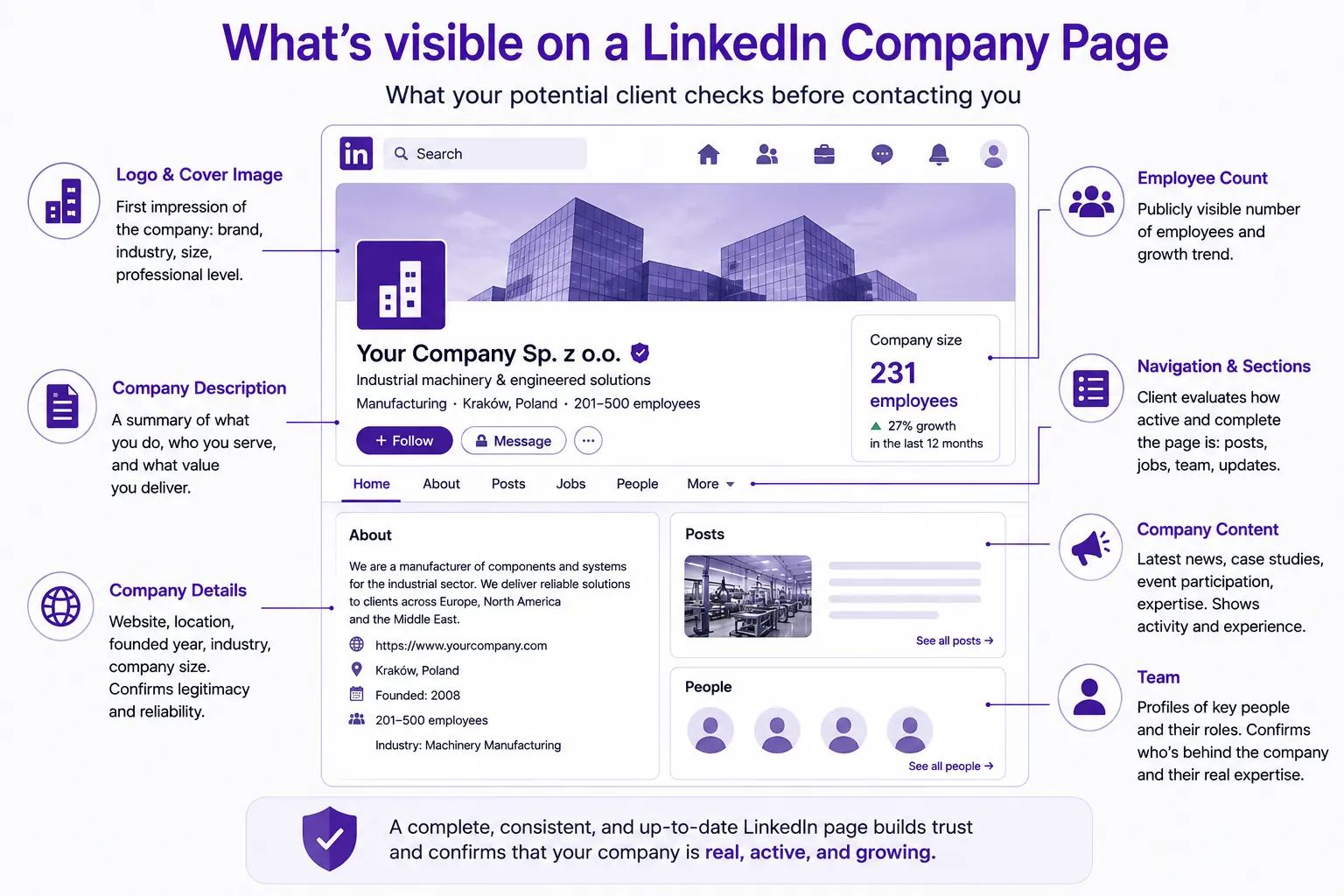
A company LinkedIn page has to repeat the positioning from the website word for word: the same value proposition, the same graphics, the same lines of business. LinkedIn is the checker’s second stop after the website, and any divergence between the two sources reads as carelessness or as an attempt to look bigger than you are.
The most common failure looks like this. On the website the company calls itself a manufacturer of complete solutions for the energy sector. On LinkedIn the description field holds one line copied from a register, the industry was picked at random, the cover image is the default grey, the logo is low resolution. This is not “unfinished”. To a buyer it signals that the company does not do external communication at all.
Everyone can see the headcount
On a company page LinkedIn publicly shows how many people list it as their employer. That is not all your staff, only those registered on the platform who linked their profile. But the person checking you does not make that allowance. They see a number and compare it with what you said.
A company that talks about 200 employees at a trade show and shows 6 on LinkedIn creates a problem out of nothing. It takes two weeks of internal work to fix: ask the team to link their profiles to the company page, tidy up job titles, add decent photographs. It costs no money and the effect is immediate.
Hiring dynamics are public too
LinkedIn shows headcount change over time. People who add your company as their workplace push the number up, those who move elsewhere pull it down. The result is an open, live indicator of whether the company is growing or shrinking. An industrial purchaser planning a three year contract looks at that curve very deliberately. They care whether the supplier will still be alive when the warranty work starts.
Why do executive profiles matter more than the company page?
Executive profiles deliver more reach and more trust than the company page. The reason is structural: people follow people, and the LinkedIn algorithm distributes personal content more widely than corporate content. A properly written profile of a business development director therefore works harder for sales than the corporate page does.
The person checking you almost always opens the profile of whoever they met and the profile of that person’s manager. They are not looking at follower counts. They are looking at three things: whether this is a real person with a history, whether they understand what they are talking about, and whether they are active now.
The minimum profile hygiene we ask for before any market entry:
- The headline describes what the person does for the client, not just the title from the org chart
- An “About” section with specifics: industries, markets, project types, scale
- A decent photograph and a cover image connected to the company’s business
- Experience entries with descriptions, not empty lines with dates
- A link to the company website in the contact details
- Regular posts about the work: a project, a solution, an observation from the market
Yes, executives get a lot of spam on LinkedIn. That is a real nuisance. But genuine enquiries from genuine companies keep arriving in the same stream, and they land in direct messages rather than at a general company address. A closed or dead executive profile shuts that channel off completely.
One more argument for executive visibility: according to the Edelman and LinkedIn report on the impact of B2B thought leadership, 40% of B2B deals stall because of misalignment inside the buying group. Your contact at the client has to convince colleagues you will never meet. Your executive’s profile with substantial posts is material they can forward. An empty profile gives them nothing to forward.
How does the sales team destroy the credibility the website built?
The third pillar of the triangle is the sales people together with everything they send out: decks, catalogues, proposals, email signatures. The materials have to repeat the language and the look of the website. When a perfect website is followed by a catalogue carrying a different logo, credibility drops instantly.
This is where everything built before it usually breaks. The company invests in the website, tidies up LinkedIn, and then a sales manager sends a PDF made three years ago by a different agency, with a different typeface, a different service list and the phone number of somebody who has left.
The list worth checking in one sitting:
- The value proposition in the deck matches the homepage word for word
- Typeface and colours in the catalogue are the ones used on the website. One typeface, one accent colour
- The product and service list is identical everywhere. If a line was discontinued, it disappears from every file at the same time
- Email on your own domain for everyone who talks to clients. A free mailbox in a signature is the cheapest way to lose credibility
- Email signatures share one structure across the team, with links to the website and LinkedIn
- The commercial proposal is built from a template, not written from scratch by a different person every time
This is the cheapest part of the triangle and the one most often skipped. Refreshing a set of materials costs a few days of work. Building a website costs months. Logic suggests starting with the cheap part, and in practice it happens the other way around. We write about how this fits into the wider sales system on our page about B2B sales development.
How do the EU, North America and the Middle East differ?
The credibility triangle works in all three markets, but the weight of the pillars differs. In the European Union formal evidence and registers matter most. In North America public activity by individuals and reviews decide the outcome. In the Middle East the first pillar becomes a personal introduction, and the digital presence confirms it afterwards.
| Market | What gets checked first | What to prepare in advance |
|---|---|---|
| European Union | The legal entity in the national register, the VAT number, certificates and standards compliance, the privacy policy | A page with registration details, certificates with numbers, product documentation in English, a correct GDPR block |
| North America | People’s LinkedIn, public activity, reviews and rankings, a clear proposition in the first two sentences | Executive profiles with regular posts, case studies with numbers, a clear statement of who you fit and who you do not |
| Middle East | Who introduced you, who vouched for you, the scale and reality of the company, your willingness to travel | Materials that can be forwarded, production photographs, a record of delivered projects, a local representative or partner |
The difference in emphasis does not cancel the underlying rule. One thing works everywhere: what you say out loud has to be confirmed online. In Europe that confirmation is looked for in registers and documents, in North America in people and their content, in the Middle East in recommendations, and after that in the same documents and people anyway.
The practical conclusion for a manufacturer planning to move beyond the home market: close the language version of the website first, then sort out LinkedIn, and only then buy the trade show stand. In the reverse order you are paying for contacts that lead nowhere.
How do you audit your own credibility triangle in one evening?
The audit takes about two hours and needs no external agency. You walk your buyer’s path: you ask an AI assistant about your own company, search the name in a private window, and open your website and LinkedIn page through a stranger’s eyes. The result is almost always uncomfortable and almost always fixable.
- Ask the AI. Open ChatGPT, Claude or Gemini and ask the question the way your buyer would: who manufactures this type of product in your country, what is known about your company, is it reliable. Write the answer down verbatim.
- Search for yourself anonymously. Private window, English interface, company name. Look at the first ten results. Count how many of them were not created by you.
- Open the site on a phone. Not on a desktop. Time how many seconds it takes to understand what you do, for whom, and where you are based.
- Verify three claims. Take three things you say at trade shows and find the evidence for each on the website. No evidence means the claim is not working yet.
- Look at the company LinkedIn page as an outsider. Description, cover image, headcount, date of the last post, completeness of executive profiles.
- Open the last deck you sent and put it next to the homepage. Same typefaces, colours, wording, list of business lines?
- Check the team’s email. Everyone on the company domain, signatures consistent, links working.
What to do with the result. Write down not “build a proper website” but specific mismatches: “no shop floor photos on the site”, “6 employees on LinkedIn instead of 90”, “old business line name in the catalogue”. Mismatches get closed in weeks. Abstract tasks never get closed at all.
The order we recommend: LinkedIn and sales materials first, because that is cheap and fast, then the language version of the website, then the work on mentions and publications.
Frequently asked questions
Is machine translation of the website enough?
No. Automatic translation does not touch PDF catalogues, captions on diagrams, item names or technical documentation, which are exactly the files that decide the matter in industrial B2B. On top of that, machine-translated industry terminology reads to a native speaker as a lack of seriousness. The minimum is your own language version with the terminology properly reviewed.
How long does it take to fix the credibility triangle?
The company LinkedIn page and executive profiles take 2–3 weeks. A full set of sales materials takes 2–4 weeks. A complete language version of the website takes 6–12 weeks depending on the size of the product section. Work on mentions and publications is continuous, with the first results visible after 3–6 months.
Is LinkedIn worth it if our buyers are not active there?
Your buyers may post nothing at all, but they do log in when they are checking a supplier. In B2B, LinkedIn is less a content channel than a public company record that gets opened during verification. It is viewed even by people who have never left a single reaction.
What if there are almost no mentions of the company online?
Start with the sources you control: exhibitor profiles on trade show websites, industry directories, association membership, the Google Business Profile, publications by partners and clients. Then expert comments in your industry’s own publications. Unlinked mentions cost less than links and in 2026 they influence visibility more strongly.
Who inside the company should own the credibility triangle?
One person with authority, most often the business development director or the commercial director. When marketing runs the website, HR runs LinkedIn and every sales manager builds their own deck, inconsistencies are unavoidable. Those are exactly the inconsistencies Gartner recorded in 69% of cases.
Want an outside view of your credibility triangle?
We go through the website, LinkedIn and sales materials with the eyes of your prospect in a specific market and show you exactly where the chain breaks. First conversation, no commitment.
Book a consultationDima V. Nechyporenko is the founder of the nech. He works with companies in Poland, Ukraine, the European Union, North America and the Middle East on strategy, B2B sales and market entry. LinkedIn · Services · Contact
Sources
- Gartner Sales Survey Finds 61% of B2B Buyers Prefer a Rep-Free Buying Experience, survey of 632 B2B buyers, August and September 2024
- Semrush: How AI Tools Shape the B2B Buying Process, 519 respondents, US, March and April 2026
- 2025 Edelman-LinkedIn B2B Thought Leadership Impact Report
- CSA Research: Consumers Prefer their Own Language, 8,709 respondents across 29 countries