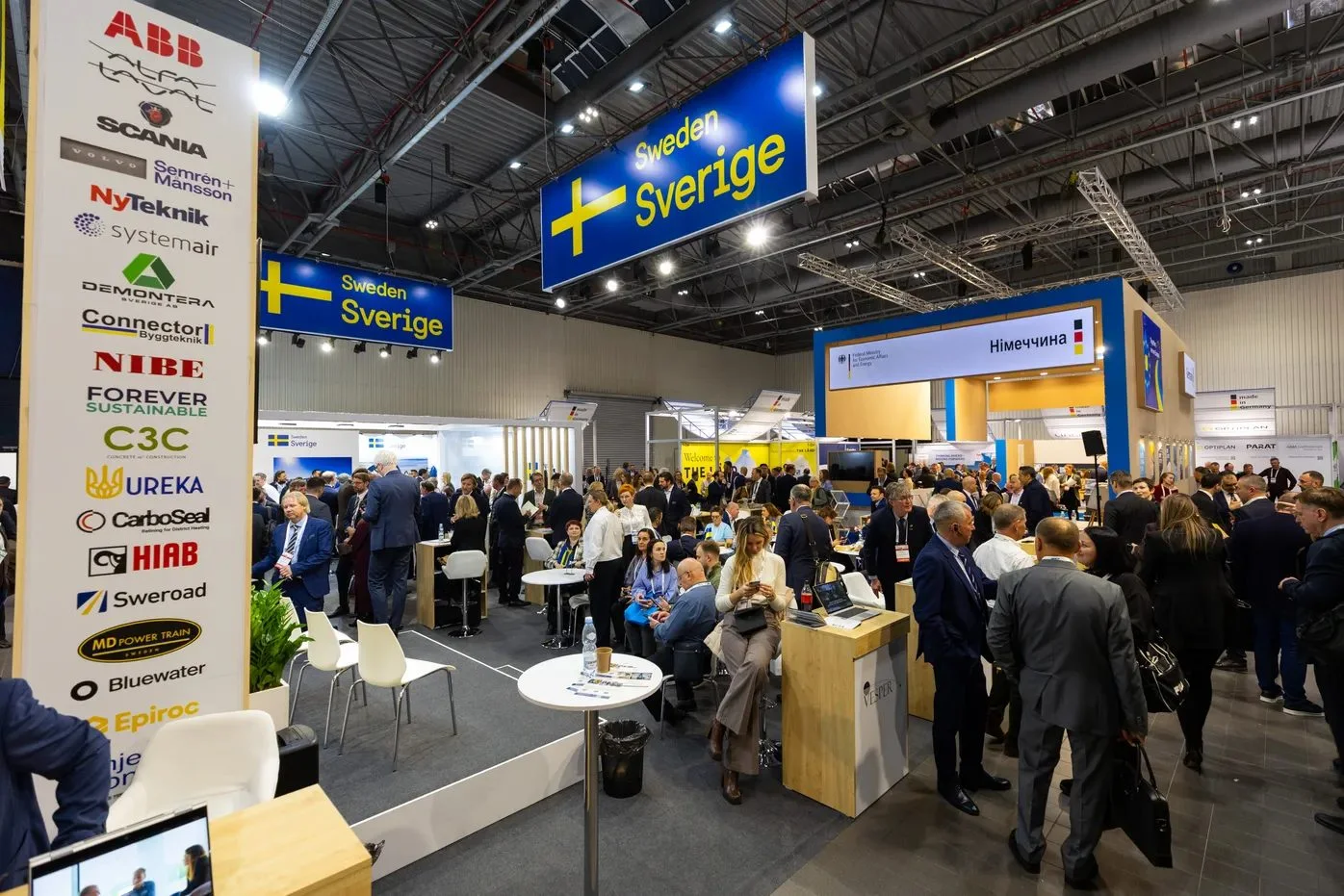
Entering a new market almost always begins the same way. A company commissions research, buys an industry report, pulls export statistics and builds a deck with market size, growth rates and competitor shares. That is a reasonable step and I never talk anyone out of it. The problem is that when the first real deal comes into view, none of those reports answer the questions that actually determine the outcome.
After years of working with companies expanding from Poland and Ukraine into the EU, the Middle East and North America, I have settled on a simple rule. Collect the analytics in parallel, not instead. And start somewhere else: with building direct contacts inside the market itself. A conversation with someone who sells, ships and clears customs there today costs less than a report and delivers more. In 2026 this is no longer a matter of taste, it is a matter of whether your data is still true.
In short
- Reports tell you how big a market is. People tell you how money is actually made in it today.
- 10–15 substantive conversations with practitioners produce more decisions than any desk research.
- Trade routes, insurance costs and tariff regimes changed faster in 2026 than any published study can track.
- The goal of stage one is not a contract. It is a pilot: one shipment, one customer, one partner.
Why entering a new market cannot be built on reports alone
Because a report describes a market in the past tense and in averages. It aggregates what has already happened and smooths over exactly the details where companies lose money. Take the example I will return to throughout this article: the UAE home furniture market is estimated at roughly 2.9 billion dollars in 2026, growing at about 4.15% a year through 2031. An excellent number for a board slide. Now try to answer these questions using it:
- What margin does the local retailer expect, and who in the chain actually earns.
- What payment terms are considered normal, and which distributor pays on time.
- Which port does your container physically enter through right now, and what does that cost this month.
- Do you need a local partner legally, or is it only a matter of convenience.
- Who already ships a similar product, and why did they win that hotel project.
- What happens to your price after freight, duty, certification, insurance and storage.
None of these has an answer in a report. All of them have an answer in the head of a person working that market right now. And that person is usually willing to talk, provided you arrive with questions rather than a pitch.
What direct contacts give you that no market report will
Four things, and each has a monetary value for a company entering a new market.
1. Verification
You take the official statistics, you take the purchased report, and you place them next to what fifteen practitioners tell you. Where three independent people say the same thing and the report says otherwise, trust the people. This is ordinary triangulation: no single source is the truth, the truth sits in the overlap.
2. Regulation as it is actually applied
Formal rules are easy to find. Practice is always messier than the rule, and it is people on the ground who will tell you which additional document customs asks for, which broker works without surprises, and why an identical shipment clears in two days or in two weeks.
3. The real economics of the deal
Two or three conversations with potential buyers give you the price band the market is willing to pay and the cost structure between you and the end customer. It is the only way to find out whether your model works at all, before you spend money on logistics and certification.
4. The contact itself as an asset
You read a report once. A contact stays with you for years and, more importantly, makes a first pilot possible. One small shipment answers more practical questions than six months of desk analysis.
Why the Middle East cannot be analysed on last year’s data
This deserves its own section, because the region is the clearest current illustration of the whole argument. The Middle East does not change gradually, it changes in steps, and the 2026 context is fundamentally different from the one in which most available research was written.
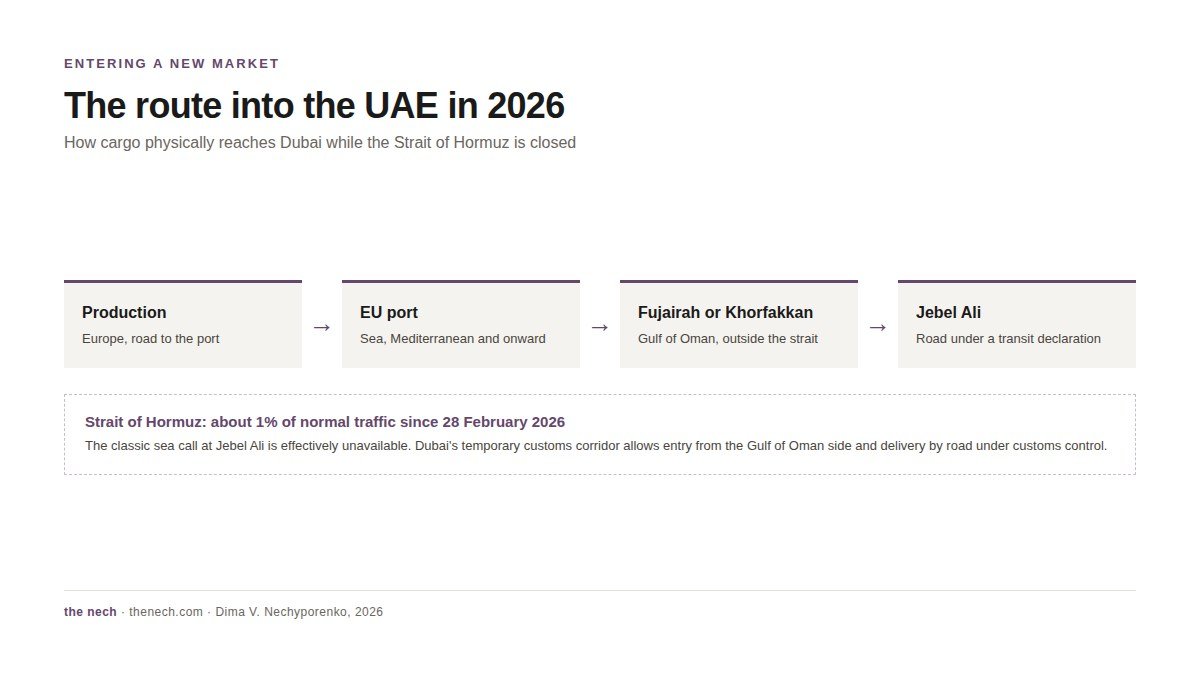
The Strait of Hormuz has been effectively closed to commercial shipping since 28 February 2026. As of 19 August, roughly one vessel a day transits it against about 73 before the crisis, close to 1% of normal traffic. War risk insurance rates rose many times over, several P&I clubs withdrew cover entirely, and Brent sits near 90 dollars, about a quarter above pre-crisis levels.
What this means operationally: Dubai Customs opened a temporary corridor. Containers land at Khorfakkan and Fujairah on the Gulf of Oman coast, outside the strait, then move by road under customs control directly to Jebel Ali and the free zones. It requires a transit declaration filed electronically before the cargo leaves the port of entry, plus guarantees until delivery. It works, it is temporary, and it can change.
Now the paradox that explains why the region should not be written off. Despite all of the above, UAE non-oil foreign trade in the first half of 2026 reached 1.9 trillion dirhams, about 517 billion dollars, up 13% year on year. Dubai’s economy is forecast by Emirates NBD to grow 4.5% in 2026, the city’s population has passed 4 million, and non-oil sectors account for more than 75% of GDP. In parallel, the UAE has signed 37 comprehensive economic partnership agreements, 18 of which are already in force.
That is not a figure of speech. Picture a report bought in December 2025. Its routes, freight rates, transit times and insurance costs belong to a different reality. The document looks credible, yet you would be deciding on data that no longer exists. Someone who shipped a container through Fujairah this week will tell you more in half an hour than that report does in a hundred pages.
Three strategic consequences follow. First, pricing for the region has to carry freight and insurance volatility, not last year’s average rate. Second, inventory held inside the region has turned from a cost into a competitive advantage, because whoever has stock in Dubai or Abu Dhabi is selling at a premium right now. Third, matters that used to be settled by email now require trust, and trust is built in person.
What to verify before entering a new market
Six blocks I work through with clients before committing. They double as the agenda for those direct conversations.
Trade regime and tariffs
Start here, because it can move your margin by double digits. Check whether your country has a trade agreement with the target market and whether your specific commodity code sits in the liberalised list. The UAE illustrates how uneven this is: Ukraine’s agreement entered into force on 1 July 2026 and removes duties on 97% of Ukrainian exports by value, while the EU is still negotiating, with a seventh round completed in July 2026 and no conclusion date. An EU exporter therefore pays the standard 5% duty on CIF value where a Ukrainian competitor pays nothing. Two suppliers, one market, different starting lines.
Taxes and payments
UAE corporate tax is 9% on profit above 375,000 dirhams, with a 0% rate retained for qualifying income in free zones under strict criteria. VAT is 5%, applied on import. The era of describing the UAE as a zero-tax jurisdiction ended in 2023, and the online articles that still say otherwise are the best possible argument against planning market entry from blog posts.
Agency and distribution law
This is where the most expensive mistakes happen, and it is jurisdiction-specific everywhere. In the UAE, Federal Decree-Law No. 3 of 2022 changed the balance for foreign principals. A commercial agency registered with the Ministry of Economy gives the agent territorial exclusivity by default, and unilateral termination becomes hard: notice of at least one year or half the contract term, whichever is shorter. Where the agent has invested in a showroom or warehouse, a five-year minimum term applies unless agreed otherwise. The agent can claim compensation by showing that their work drove the growth in sales.
In practice: while testing a market, work with an unregistered distributor, include an arbitration clause, and grant either no exclusivity or exclusivity tied to a sales plan. Register an agency only when you are deliberately building a five-year-plus relationship. Your prospective agent will never raise this. Two other foreign suppliers who have already lived through it will explain it in detail, which is one more argument for direct contacts.
Certification and documents
Check whether your product category appears on the regulated products list of the relevant authority. In the UAE that is the Ministry of Industry and Advanced Technology, and regulated goods require a certificate of conformity under the ECAS scheme before import, supported by accredited test reports, labelling and documentation in English and Arabic. Furniture is largely unregulated, while textiles and components may not be, so the answer depends on the commodity code rather than the product name. The baseline customs pack rarely changes anywhere: commercial invoice, certificate of origin, packing list, customs declaration.
Form of presence
Three options in most markets. Direct export to a local distributor with no legal entity of your own, which is the fastest and cheapest way to test. A company in a free zone, meaning full foreign ownership with restrictions on selling into the domestic market. A mainland company, meaning access to the domestic market and public tenders. Choose by who your buyer is, not by how elegant the structure looks.
Deal culture
Decisions in the Gulf take longer than the first meeting suggests and move faster than the fifth meeting suggests. Physical presence outweighs presentations, and an introduction from a mutual contact opens doors no email sequence will. This is the part you cannot read your way into.
How to find the right people when entering a new market
Contrary to common belief, finding the companies is not hard. Getting into direct conversation with them is. These are the channels that work best for me, in order of return.
- Exhibitor lists. The exhibitor catalogue of an industry trade show from the past 2–3 years is a ready-made database of qualified players, available for free, with the non-investors already filtered out.
- LinkedIn. Search by role and company, then send a short message that does not sell. The formula: who you are, why this person specifically, one concrete question, no catalogue attached.
- Instagram. In the Gulf this is a working channel for furniture, interiors, retail and hospitality. Many local companies run the account more actively than the website, and the owner often replies personally.
- Industry associations, chambers of commerce and your country’s trade office. They exist to make introductions, and many run export support programmes worth checking before you spend your own money.
- Freight forwarders and customs brokers on the ground. In 2026 this is a uniquely valuable source, because they are the first to know how a route actually behaves this week.
- Distributors of adjacent categories. Whoever ships the hardware knows everyone who ships the furniture.
The first-message rule
Do not sell. Ask for 15 minutes about the market and be honest about why. People share expertise far more willingly than they read commercial proposals from a company they have never heard of. Reply rates on this approach have consistently been several times higher in my projects than on classic cold outreach.
Why a trade show is the fastest route into a new market
Because it compresses time. In three days in one hall you meet as many decision-makers as cold outreach would gather in a quarter. You also handle competitor product, hear how they justify their pricing, and learn which segment makes you look expensive or cheap. In the current context there is one more benefit: over three days you will hear from a dozen companies how they are really moving cargo and what hurts right now.
Go in two steps. First attend as a visitor, which costs about the same as an industry report and yields more. A year later, once you know who you are selling to and what, take a stand. A trade show without a prepared meeting list is money spent; a trade show with thirty pre-agreed conversations is a tool.
For the furniture vertical in this region the anchors are INDEX Dubai, held 28–30 September 2026 with the next edition scheduled for 1–3 June 2027 at the Dubai World Trade Centre, and Dubai WoodShow, traditionally held in spring. Confirm dates with the organisers, and if your country’s trade agency runs a national pavilion, ask about it before booking anything privately.
Worked example: a furniture manufacturer entering the UAE
Picture a European furniture producer planning entry into the United Arab Emirates. The market is unusual in that large international chains and a long tail of local companies compete side by side, from family showrooms to fit-out contractors serving hotels and developers. Finding them is easy. Getting into direct conversation is not.
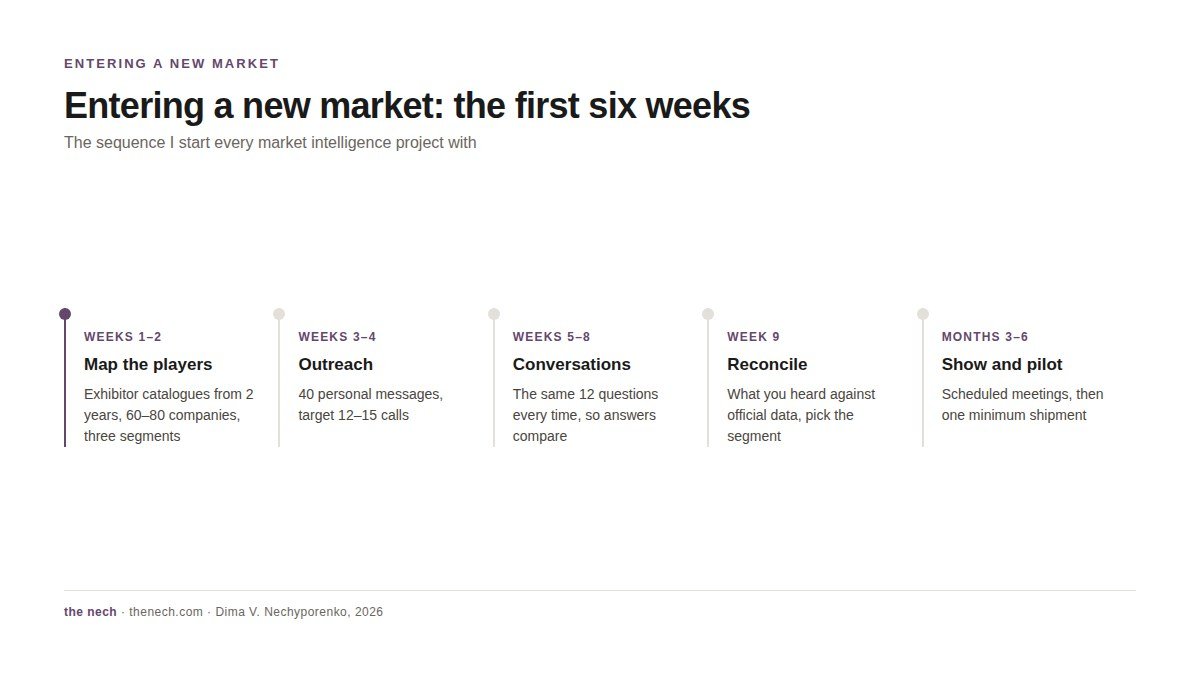
- Weeks 1–2. Pull the exhibitor catalogues, build a list of 60–80 companies, split into three segments: retail, project contractors, distributors. In parallel, check your commodity codes against any applicable trade agreement.
- Weeks 3–4. LinkedIn and Instagram, 40 personal messages, target 12–15 short calls. Separately, two calls with freight forwarders about real routes and transit times.
- Weeks 5–8. The conversations. Ask the same 12 questions every time so the answers can be compared.
- Week 9. Reconcile what you heard against the official data. This is usually where the real finding appears.
- Months 3–4. Travel to the trade show with a full meeting schedule and samples, not a catalogue.
- Months 5–6. A pilot shipment to one partner. Minimum volume, maximum learning, and a contract without agency registration or exclusivity at the start.
What this work reveals in this particular case: UAE wood imports exceed a billion dollars and China is the leading supplier. A European producer will not win on price in the mass assortment, and that becomes obvious after the fifth conversation rather than after the second container.
What surfaces repeatedly instead is a different theme: lead times, customisation and willingness to work to a project specification. That points at hotels, offices and developer projects, where the fit-out contractor decides rather than a chain buyer. Add the tariff position of your own country and the current premium on predictable delivery, and you arrive at a positioning that would have looked non-obvious a year ago. That is the conclusion worth starting with people for. It changes the strategy, not the tactics.
How to verify official data through conversations
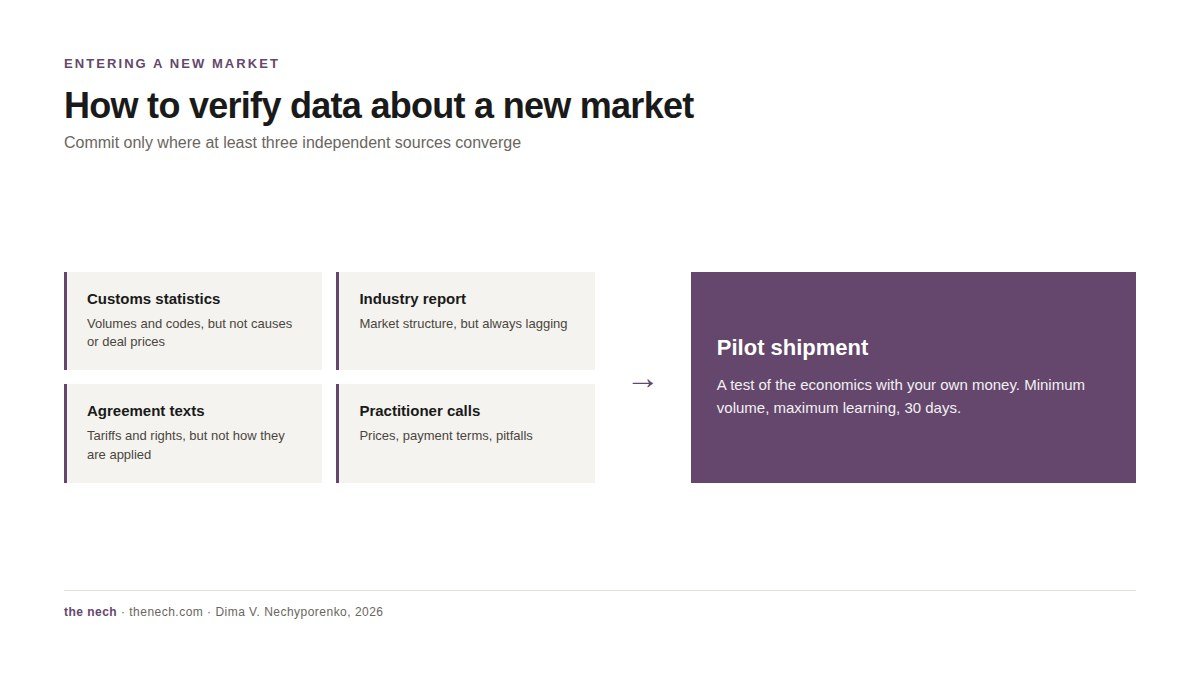
| Source | What it does well | What it will not give you |
|---|---|---|
| Public statistics and customs data | Volumes, trends, supplier countries, commodity codes | Causes, transaction prices, buyer behaviour |
| Purchased industry report | Market structure, segments, forecasts, player lists | Currency, local exceptions, real terms of trade |
| Agreement texts and legislation | Tariffs, liberalisation schedules, rights of the parties | How it is applied in practice and where the risk sits |
| Conversations with practitioners | Prices, payment terms, pitfalls, the real competition | Objectivity, representativeness of a single opinion |
| Pilot shipment | A test of the economics and the process with your own money | Scale, statistical significance |
The rule: commit only where at least three sources from different rows converge. If the report and the statistics say one thing and every practitioner says another, that is not a reason to dismiss the people. It is a reason to work out what the report failed to capture.
What to do with contacts after the first meeting
The largest waste of money in market entry happens after the search, not during it. Business cards sit in a drawer, the follow-up never starts, and six months later nobody remembers you. So I hold a strict rhythm.
- 72 hours. A personal email to each contact, built on something specific from the conversation, not a template.
- 2 weeks. Commercial terms and samples to everyone who replied.
- 30 days. A pilot agreed with at least one partner.
- 90 days. A decision: scale this market, change the entry model, or stop.
Common mistakes I see most often
- Waiting for perfect analytics. Markets change faster than research finishes.
- Planning entry from internet articles. Half the material on the UAE still describes a corporate tax rate abolished in 2023.
- Signing exclusivity and registering an agency at the start. Unwinding that later is slow and expensive.
- Attending a trade show without a meeting list. A stand without preparation is decoration.
- Asking different questions of different people. The answers cannot be compared.
- Measuring success in business cards rather than in second conversations.
How to start entering a new market this month
- Pick one market and one segment. Not three countries at once.
- Check your commodity codes against every trade agreement that applies to you.
- Write 12 questions and ask all of them in every conversation.
- Download the exhibitor catalogue of the relevant trade show for the past 2 years.
- Shortlist 50 companies and find named people, not info@ addresses.
- Send 40 personal messages over two weeks.
- Get three quotes from freight forwarders on the current route.
- Run 10–15 conversations and reconcile them with official data in one table.
Entering a new market this way takes roughly six weeks and costs less than an average industry report. From there you decide on facts rather than assumptions. This is where we start on market expansion, business strategy and B2B sales development projects.
Frequently asked questions
Can you plan entering a new market without buying expensive research?
Yes. Entering a new market can be prepared on open sources: customs statistics, trade agreement texts, exhibitor catalogues and industry associations. A purchased report becomes useful once you already know which questions to put to it.
How many conversations does it take to understand a new market?
At least 10–15 substantive conversations within one segment. Around the tenth, answers start repeating, and that repetition is the signal that your sample is sufficient for first decisions.
Trade show or LinkedIn: where should you start?
LinkedIn, because it is cheaper and faster. The trade show belongs to step two, once you know who you want to meet. The best results come from the combination: outreach 6–8 weeks before the event, meetings at it, and follow-up within 72 hours after.
Should you sign exclusivity with a distributor straight away?
Not while testing a market. In the UAE, a registered commercial agency under Federal Decree-Law No. 3 of 2022 gives the partner territorial exclusivity and strong protection on termination, including compensation and long notice periods. Similar protective regimes exist in many jurisdictions, so check before you sign.
Does it still make sense to enter the UAE during regional instability?
Yes, with open eyes. UAE non-oil trade grew 13% in the first half of 2026 despite the closure of the Strait of Hormuz, and Dubai’s economy is forecast to add 4.5% this year. The risk moved from demand into logistics and insurance, so plan entry with alternative routes, regional inventory and pricing that absorbs freight volatility.
Planning to enter a new market?
We will review your product, choose the market and segment, and build a first 90-day plan: from the contact list to the pilot shipment.
The first conversation is free. We reply within one business day.

Dima V. Nechyporenko
Founder of the nech, a B2B advisor on business strategy and market entry. Works with companies across Poland, Ukraine, the EU, Canada and the UAE on strategy, sales development and international expansion.
Sources, verified 20 August 2026:
- Mordor Intelligence: UAE home furniture market size and forecast.
- Straits Live and Middle East Briefing: Strait of Hormuz status and Gulf supply chains.
- Splash247: temporary customs corridor from Khorfakkan and Fujairah to Jebel Ali.
- AGBI: UAE non-oil trade in H1 2026 and EU–UAE negotiations.
- Ukraine–UAE CEPA text and Interfax-Ukraine on its entry into force.
- Emirates NBD via Digital Dubai: Dubai economic forecast for 2026.
- UAE Federal Decree-Law No. 3 of 2022 on commercial agencies.
- SGS: ECAS and Emirates Quality Mark conformity schemes.
- INDEX Dubai and the organisers: trade show schedules.
Disclaimer
This article is provided for general information only. It is not legal, tax, customs, financial or investment advice, and it is not an individual recommendation.
The data is current as of 20 August 2026 and is subject to change: tariffs, regulations, currency and travel rules, shipping routes and certification requirements are updated frequently. Every case is individual and requires its own approach, taking into account your product, commodity code, corporate structure and counterparty. Before making decisions, verify the current rules in primary sources and engage qualified professionals: a lawyer, a tax adviser, a customs broker and your bank. Reading this article does not create an adviser and client relationship. Neither the author nor the nech accepts liability for decisions made on the basis of this text.