Market analysis · August 2026
Canada-Poland trade: why Canadian companies are arriving now
Canadian investment in Poland rose 52.1% in a single year, and Export Development Canada is opening a Warsaw office. Here is what actually works in this corridor — and what does not.
Canada-Poland merchandise trade reached CAD 5.3 billion in 2025, and Canadian direct investment in Poland grew 52.1% in one year to CAD 2.1 billion. Around 60 Canadian companies now operate in Poland, employing roughly 17,000 people. CETA removed tariffs on 99% of tariff lines between the two countries.
Two things happened to Canada-Poland trade in the same twelve months, and together they explain why I now get calls from Canadian companies that had never considered Central Europe.
The first is that Canada lost predictability in its largest market. On 1 July 2026 the United States declined to extend CUSMA in its current form at the six-year joint review; the agreement runs to 2036, but with annual reviews and no automatic extension (White & Case, July 2026). On 22 August 2026, 50% tariffs took effect on roughly USD 20 billion of Canadian exports — the first time CUSMA-compliant goods were hit without exemption (PBS, 22 August 2026).
The second is that Poland became too large to route around. It is the sixth-largest economy in the European Union, growing at roughly 3.5% a year on the European Commission’s forecast, with unemployment near 3% on the Eurostat measure.
I work from Warsaw with B2B companies on strategy, market entry and sales. What follows is how Canada-Poland trade actually operates — the institutions that will help you, the one that will not, and the practical mechanics most first-time entrants get wrong.
CAD 5.3bn in two-way trade
+52.1% Canadian investment in one year
60 companies already on the ground
Why are Canadian companies choosing Poland?
Poland offers a less saturated market than Western Europe with faster growth and full CETA access to the entire European single market. Export Development Canada is opening a Warsaw office in 2026, and Canadian exports to Poland rose 35.6% in 2025 — the fastest growth in the bilateral relationship.
Klaus Houben, EDC’s business development director for Europe, puts the case plainly: “Poland has emerged as a powerhouse within Central and Eastern Europe. This region offers less saturated markets than Western Europe, with growing demand” (EDC, 28 January 2026). EDC is backing that with an in-market team in Warsaw during 2026.
The wider diversification is measurable, not rhetorical. In October 2025 Prime Minister Mark Carney set a target of doubling non-US exports by 2035 (Bloomberg). One year on, the numbers moved (goods and services combined):
- non-US share of Canadian exports: 32.8% in 2025 — the highest in four decades
- exports to non-US markets: +11.1%, or CAD 33.3 billion
- exports to the United States: −3.7%, a third consecutive annual decline
- merchandise exports to the EU: CAD 42.8 billion, +23.4% year over year
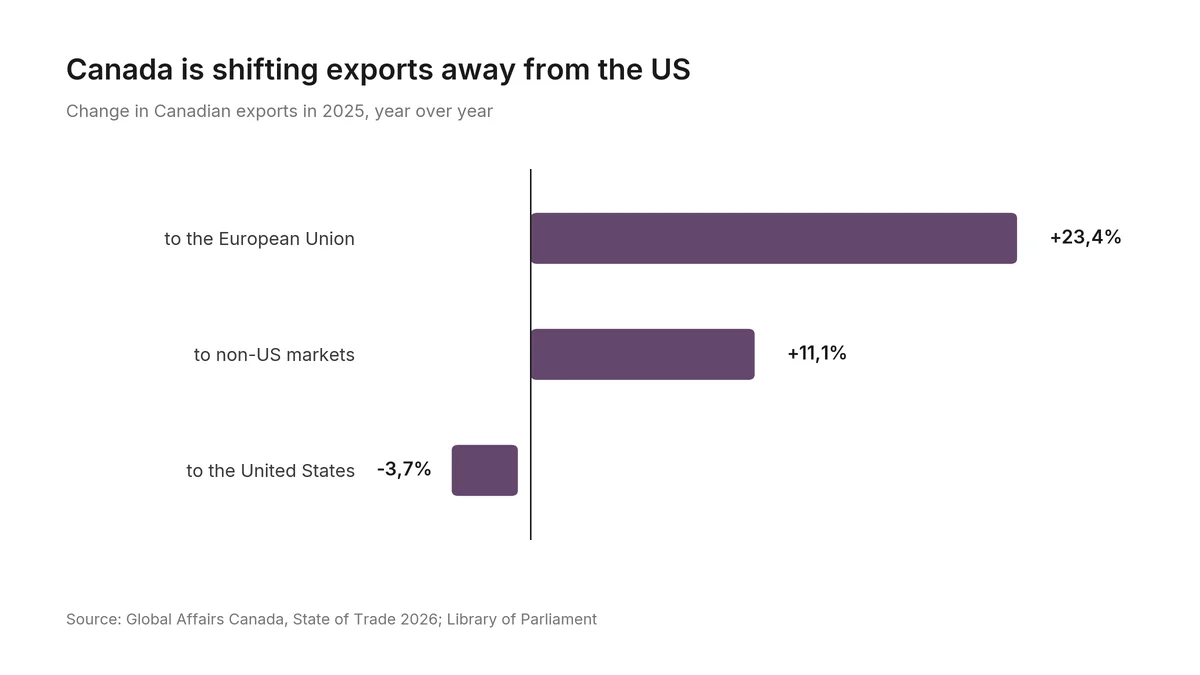
Sources: Global Affairs Canada, State of Trade 2026 · Library of Parliament, 27 May 2026
One number deserves an honest caveat, and I will return to it in the conclusion: the EU is still only 5.5% of Canadian exports, up from 4.4%. Growth is fast, but from a low base. Europe is not yet Canada’s first-choice market — it is the market Canada is only now taking seriously. For a company arriving today, that is good news: it is easier to be the first conversation than the tenth.
How large is Canada-Poland trade?
Two-way merchandise trade totalled CAD 5.3 billion in 2025. Canada imported CAD 3.8 billion from Poland and exported CAD 1.5 billion, so Poland holds the surplus. Canadian direct investment in Poland stands at CAD 2.1 billion after growing 52.1% in a year, while Polish investment in Canada is CAD 4.4 billion.
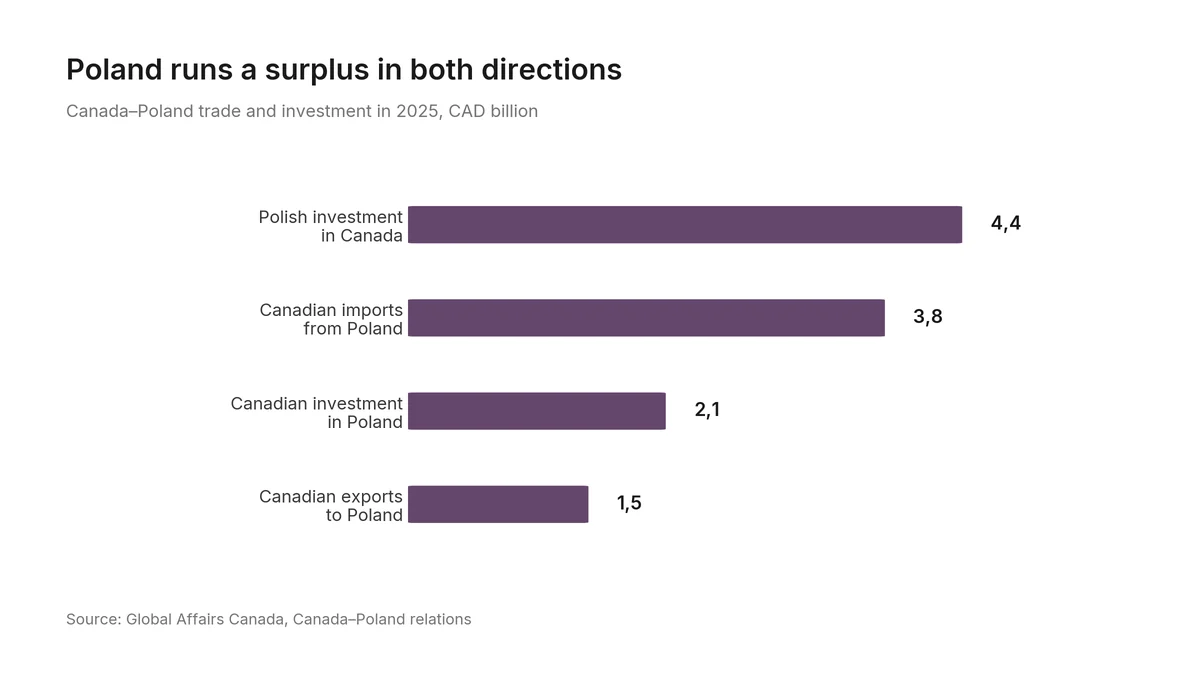
| Indicator | 2025 | Change y/y |
|---|---|---|
| Total merchandise trade | CAD 5.3bn | — |
| Canadian imports from Poland | CAD 3.8bn | +8.8% |
| Canadian exports to Poland | CAD 1.5bn | +35.6% |
| Canadian investment in Poland | CAD 2.1bn | +52.1% |
| Polish investment in Canada | CAD 4.4bn | — |
Source: Global Affairs Canada, Canada-Poland relations. Polish statistics use a different basis and currency — do not mix the two datasets in one sentence.
Canada’s Ambassador to Poland, Catherine Godin, said in an interview on 12 August 2026 that around 60 Canadian companies operate in Poland employing roughly 17,000 people, and that bilateral trade grew 54% in 2025 on the embassy’s basis. She also offered the statistic I like most, because it shows this is not only a heavy-industry story: Polish hard cheese exports to Canada rose more than 500% (xyz.pl, 12 August 2026).
Which Canadian companies already operate in Poland?
Alimentation Couche-Tard runs over 380 Circle K stations in Poland and agreed in July 2026 to acquire Żabka Group for PLN 32.62 billion. Northland Power holds 49% of the Baltic Power offshore wind farm, Kinterra Capital is building a battery materials plant in Opole, and McCain, CGI, TELUS Digital, CAE, Genetec and WSP all have Polish operations.
I am writing here about civilian business only. Defence and nuclear are also active in this corridor, but they are a different category of buyer and a separate article.
Retail and consumer
Alimentation Couche-Tard of Québec operates more than 380 Circle K stations in Poland. On 31 July 2026 it announced an agreement to acquire a controlling stake in Żabka Group — over 13,000 convenience stores across Poland and Romania, at PLN 32.00 per share, valuing the equity at PLN 32.62 billion (USD 8.6 billion). It is the largest acquisition in the company’s history, with closing expected no later than December 2026 subject to regulatory approvals (Couche-Tard release).
Energy and critical minerals
Northland Power of Toronto holds 49% of Baltic Power alongside Orlen’s 51% — Poland’s first offshore wind farm. Roughly 1.2 GW, 76 turbines of 15 MW each, about 23 km offshore between Łeba and Choczewo, with first power delivered on 10 July 2026 (Northland Power).
Kinterra Capital took over the collapsed Ascend Elements project in 2026 and is building a battery materials plant at Opole-Wrzoski: 45 hectares, roughly PLN 7 billion, with a PLN 1.22 billion government grant (Notes from Poland). Lumina Metals is developing a copper-silver project near Nowa Sól, raising about CAD 406 million in a Toronto IPO in April 2026 before a June dual listing in Warsaw (StockWatch).
Food, services and technology
McCain Foods has been in Poland since 1993, with a frozen potato plant at Strzelin near Wrocław operating since 1999 — in 2022 it became McCain’s first plant in continental Europe running fully on renewable power (McCain Poland). CGI of Montréal has operated in Poland since 1996 and has offices in twelve cities. TELUS Digital has run a Gdańsk site since 2014. CAE opened a software development centre in Kraków in 2022, and Genetec opened an R&D centre there in 2024. WSP Poland has provided engineering and consulting since 1999.
The corridor runs both ways.
Polish capital in Canada — CAD 4.4bn —
is larger than Canadian capital in Poland.
Which Polish companies operate in Canada?
Polish investment in Canada totals CAD 4.4 billion and is concentrated in mining. KGHM International entered in 2012 by acquiring Quadra FNX Mining for CAD 2.9 billion and now develops the Victoria project in Ontario. Orlen Upstream Canada operates from Calgary, and Comarch, PCF Group and Solaris are active in services and manufacturing.
This matters to a Canadian reader for a practical reason: Canada-Poland trade is a corridor with traffic in both directions has service providers, precedent and institutional attention that a one-way corridor does not.
The Quadra FNX acquisition remains the largest Polish investment in Canada. KGHM’s main asset today is the Victoria project in the Sudbury Basin, Ontario — a copper-nickel-PGM deposit targeting 3,500 tonnes per day over roughly a 14-year mine life. Shaft sinking reached about 1,484 m in July 2026, with advanced exploration running to mid-2028 and a final investment decision still pending (International Mining, 27 July 2026).
Worth noting, because it is underreported: in February 2025 KGHM sold its producing Sudbury mines — McCreedy West, Levack, Podolsky and Kirkwood — to Magna Mining for about CAD 33.3 million plus up to CAD 24 million in contingent payments, retaining a 4% NSR royalty on new discoveries (Magna Mining, 28 February 2025). KGHM’s Canadian footprint is now a single development project.
Elsewhere: Orlen Upstream Canada has operated from Calgary since 2013 with Alberta assets at Kakwa, Ferrier, Lochend and Kaybob. Comarch maintains three Canadian offices — Saint John, New Brunswick and two in Montréal. PCF Group opened a Montréal game studio in July 2023. In March 2025 Solaris signed its first Canadian contract, supplying 107 Trollino 12 trolleybuses to TransLink in Vancouver with options for several hundred more (Solaris).
What support is available to Canadian exporters in Poland?
The Canadian Trade Commissioner Service operates from the Embassy of Canada in Warsaw and serves Canadian companies directly. Export Development Canada is opening a Warsaw office in 2026. On the Polish side, the Polish-Canadian Chamber of Commerce in Warsaw has more than 70 member companies.
| Organisation | Who it serves | What it provides |
|---|---|---|
| Trade Commissioner Service, Warsaw | Canadian companies | market intelligence, vetted local providers, CETA guidance |
| Export Development Canada | Canadian exporters | financing and insurance; Warsaw office from 2026 |
| CanExport SMEs | Canadian SMEs, min. 3 FTE | funding for market development, up to 5 target markets |
| PCCC (Warsaw) | both sides | bilateral chamber, 70+ members, events |
| CPCC (Toronto) | both sides | bilateral chamber, founded 1994 |
Embassy of Canada, ul. Jana Matejki 1/5, Warsaw · trade section: wsaw-td@international.gc.ca · +48 22 584 3360 · covers Poland and Belarus. Source: TCS — Poland
The Warsaw trade section’s civilian priority sectors include aerospace, agriculture and processed foods, clean technology, fish and seafood, and information and communications technology. Eligibility is straightforward for a Canadian company: TCS serves export-ready Canadian firms and organisations, along with foreign divisions of Canadian-registered entities that can show meaningful economic ties to Canada (TCS eligibility).
Note the mirror image, because it shapes who you will meet: a Polish company cannot use the TCS. That asymmetry means Polish firms seeking Canadian partners come through PAIH, chambers and trade fairs instead — PCCC in Warsaw and CPCC in Toronto are where that traffic concentrates.
How does CETA work for a Canadian exporter?
CETA eliminated tariffs on 99% of tariff lines, with 98% removed immediately on 21 September 2017. A Canadian exporter claims preference by providing an origin declaration on a commercial document using its CRA business number. Canadian exporters do not use the EU’s REX system, which applies only to EU-based exporters.
This is the single most common administrative error I see, in both directions. On the Canadian side the origin declaration carries your CRA business number; there is no separate registration to obtain. On the EU side, an exporter shipping over EUR 6,000 must be registered in REX (EDC on REX; Polish Ministry of Finance CETA guide).
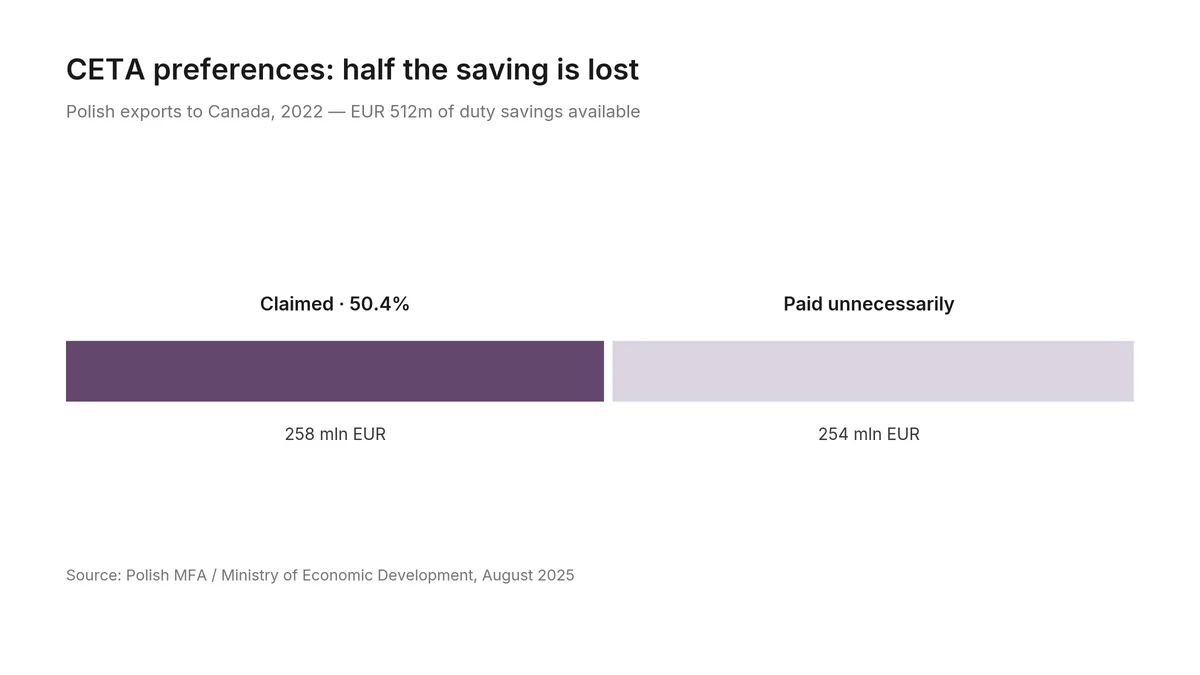
How much does getting this wrong cost? In 2022 Polish exporters claimed CETA preferences on only 50.4% of eligible trade with Canada, against an EU average of 62.5%, realising EUR 258 million of a possible EUR 512 million in duty savings (Polish MFA/Ministry of Economic Development, August 2025). Nobody forgets to pay duty. People forget to complete the document that waives it.
What is not covered by CETA yet?
CETA’s investment protection chapter and Investment Court System are not in force, because full ratification requires all 27 EU member states and only 17 had ratified as of March 2026. Poland is among the ten that have not. The trade provisions are unaffected and apply in full under provisional application.
For an exporter this changes nothing. For a Canadian company building a plant in Poland it does: your treaty protection today comes from the bilateral Canada-Poland investment agreement of 1990, not from CETA (Torys, 17 March 2026). That is a narrower and older instrument, and it should be reviewed before capital is committed.
Movement is happening. On 5 March 2026 the CETA Joint Committee in Toronto adopted expedited arbitration procedures for SMEs, extended the GMP protocol to active pharmaceutical ingredients, and formally launched negotiations on an EU–Canada digital trade agreement. A mutual recognition agreement for architects — the first of its kind under CETA — has applied since 18 December 2025 (European Commission, 5 March 2026).
How should a Canadian company enter the Polish market?
Start by confirming your tariff position and origin documentation, then decide whether you are exporting or establishing. Poland is a single market of 37 million people but functions as a gateway to the wider EU, so the entry decision should be made at European scale rather than country scale.
- Confirm your tariff line and origin paperwork. Check your HS code against the EU tariff in Access2Markets, then confirm your commercial invoices carry a correctly worded origin declaration with your CRA business number. This is an afternoon of work that frequently pays for itself on the first shipment.
- Decide: export, partner, or establish. Exporting through a distributor needs no Polish entity. Establishing one unlocks public procurement, local hiring and EU-wide operations — and brings Polish corporate, employment and tax obligations. These are different budgets and different timelines; pick one deliberately.
- Treat Poland as a gateway, not a destination. CETA gives Canadian suppliers the same access to Polish public contracts as EU suppliers. A Polish entity trades freely across the single market. Sizing the opportunity at 37 million people rather than 450 million is the most expensive mistake I see Canadian entrants make.
- Check conformity assessment early. The CETA protocol on mutual acceptance of conformity assessment covers several product categories but not all of them. Establish whether yours is covered before you model revenue — certification timelines, not tariffs, are what usually delay a launch.
- Localise more than the language. Polish B2B buying is relationship-led and formal in first meetings. Pricing in EUR or PLN, local payment terms, a named contact in the same time zone and a clear answer on warranty service are what convert a first meeting into a contract.
When does the Polish market not make sense?
Poland does not work for products whose margin cannot absorb transatlantic freight, or for companies unwilling to staff a European time zone. It also does not work where the product requires EU conformity assessment the company has not yet obtained and cannot obtain within its planning horizon.
I will not argue that every Canadian company should look at Poland. The EU is still only 5.5% of Canadian exports, and the largest growth in Canada’s non-US sales in 2025 came from gold and crude oil — not the manufactured goods and services most of my clients sell. Asia-Pacific has absorbed more of the shift than Europe has.
Three situations where I advise against it:
- Low unit value, high weight. Transatlantic freight will consume the margin before the goods clear Gdańsk. Zero tariff does not fix negative unit economics.
- No capacity for European-hours support. Poland is six to nine hours ahead of Canadian time zones. If the same person sells and handles warranty claims, this will not hold.
- Uncertified product in a regulated category. If your category falls outside the CETA conformity assessment protocol, budget for full EU certification before you budget for revenue.
What I do argue is narrower and, I think, more useful: for the first time since CETA was signed, both sides have a reason to open this corridor wider at the same moment. Canada because it must. Poland because it is growing, holds a persistent trade surplus with Canada, and is where Canadian capital grew 52.1% in a single year.
The institutions behind Canada-Poland trade are being built right now — EDC in Warsaw during 2026, PAIH in Toronto since 2017, a digital trade agreement under negotiation. A coincidence like this one — pressure on one side, growth on the other, and infrastructure arriving in between — does not happen often and does not last long.
Frequently asked questions
Do Canadian goods pay tariffs entering Poland?
In most cases no. CETA eliminated tariffs on 99% of tariff lines, with 98% removed immediately in September 2017. To claim the preference, provide an origin declaration on a commercial document quoting your CRA business number. Canadian exporters do not register in the EU’s REX system.
Do I need a Polish entity to sell in Poland?
No. Exporting through a distributor or agent requires no Polish company. An entity becomes necessary for local hiring, participation in public procurement as an established supplier, VAT-efficient EU-wide distribution, or where a client requires a local contracting party.
Can Canadian companies bid on Polish public contracts?
Yes. CETA gives Canadian suppliers access to Polish public procurement on the same terms as EU suppliers, across central, regional and local government levels. Tender documentation is normally in Polish, and translation and local representation are practical requirements rather than legal ones.
How long does entering the Polish market take?
With a certified product and a distribution partner, six to twelve months to first repeatable sales is realistic. Establishing a Polish entity and building a direct structure runs eighteen months and upward. The usual bottleneck is EU conformity assessment, not company registration.
Is my investment in Poland protected under CETA?
Not currently. CETA’s investment protection chapter and Investment Court System require ratification by all 27 EU member states, and Poland is among the ten that have not ratified. Treaty protection today comes from the bilateral Canada-Poland investment agreement of 1990, which is narrower in scope.
Considering Poland as a market?
I have worked both sides of Canada-Poland trade: with foreign companies entering the Polish market, and with Polish companies building sales abroad. In a consultation we work through the specifics — whether your product prices sensibly in Poland once freight and certification are counted, whether to export or establish, who your realistic first customers are, and what has to be ready before you send a first quote.
Book a consultationDima V. Nechyporenko
Founder of the nech. Works with B2B companies in Poland and across Europe on strategy, market entry and sales development. Experience across Poland, Ukraine, the EU, Canada and the UAE. Working languages: EN, PL, UA.
Read next
- Polish market entry — the process we run, step by step
- Market expansion strategy — choosing and sequencing markets
- Business development in Poland — building a pipeline from zero
- Sales development — turning market access into revenue