Market entry
Market entry discovery: how to test a new market before you commit budget
A market entry discovery phase takes one to three months and ends in one of two places. You adapt the offer, or you walk away before the money is spent.

In short
- A market entry discovery phase runs one to three months, from desk research to a go or no-go decision.
- It combines two things: desk research, and 20 to 30 structured conversations with potential buyers, partners and industry associations.
- SMEs make up 97.1% of companies exporting inside the EU but generate only 39.4% of intra-EU export value (Eurostat, 2024 data). Crossing a border is common. Building volume is not.
- The deliverable is not a report. It is a decision, plus the exact degree of localisation your offer needs.
- We run discovery from Warsaw, in Polish, English and Ukrainian, in both directions: into the EU through Poland and Ukraine, and out of Poland and Ukraine into the EU, the United States, Canada and the Middle East.
What is a market entry discovery phase?
A market entry discovery phase is a structured test of your assumptions about a foreign market, run before you spend on marketing, a local entity or local staff. It pairs desk research with direct conversations with buyers and partners. It takes one to three months and ends with a decision, not a document.
International expansion rarely starts with a strategy document. It usually starts with a spark. A competitor opens an office abroad, someone comes back from an industry trade fair with a folder of business cards, or a report lands in the inbox with a growth curve on page three. The thought forms in a single sentence: why not us.
Discovery exists to slow that sentence down for eight to twelve weeks. Not to kill it. To price it. The cost of the discovery phase is a rounding error next to the cost of a local entity, a first hire and a year of marketing spend aimed at the wrong buyer.
Why is your first view of a new market wrong?
Because the first view is assembled from the outside. Press releases, trade fair impressions and market reports describe market size, growth rates and competitor names. They do not describe buying habits, procurement rules, payment terms, or who inside the client organisation actually signs. That gap is where expansion budgets disappear.
The pattern repeats across sectors. A supplier reads that Poland has one of the fastest growing energy storage pipelines in the region and concludes there is room for another vendor. The number is real. What the number does not say is that the buyers in that pipeline already have framework agreements, that local service response time is a scoring criterion in half the tenders, and that the decision is made by a technical director who has never heard of the brand.
None of that is hidden. It simply is not written down anywhere you can read it. It lives with people, and it comes out in conversation. That is the whole argument for a rigorous discovery phase instead of another report.
What does desk research actually cover?
Desk research maps the baseline before anyone is contacted. It covers public registers, tender and procurement databases, financial filings, association membership lists, local trade media and industry clubs. Two to three weeks of it produces a target list, not a conclusion.
In practice we work through six layers:
- Public registers. In Poland the REGON register held 5.44 million registered entities at the end of January 2026 (GUS). Registers tell you who exists, since when, and how large.
- Financial filings. Filed accounts show whether a potential client or competitor is growing, stalling or being financed by its parent.
- Tender and procurement databases. Past awards show the real price levels and the real qualification criteria, not the ones in the brochure.
- Associations and industry clubs. Membership lists are the fastest route to a segmented map of the sector.
- Local trade media. Niche publications carry the arguments the sector is currently having. That is where positioning comes from.
- Competitor footprint. Who is already selling something adjacent, through which channel, and at what service level.
Desk research ends with a short list of companies, associations and individuals worth talking to. It is the input to the next stage, and on its own it is worth very little.
How do you run discovery by doing?
By opening conversations instead of pitching. We approach the short list with a request for expert perspective, not a sales offer. The framing matters: people decline a pitch from an unknown foreign supplier, and accept an invitation to comment on their own market.
The opening line we use is close to this, in the local language:
We are exploring an expansion into this market with this solution, and we need your feedback to validate our assumptions.
Two things follow from that framing. Response rates go up, because nobody is being sold to. And the answers are usable, because the person is describing how their market works rather than defending a budget. This is the same mechanism behind direct market engagement and behind the way we build a short list of potential clients, partners and key associations.
A conversation is structured, not a chat. Every one of them covers the same six points: how the buyer currently solves the problem, what triggered the last change of supplier, who signs, what the qualification bar is, what the realistic price band is, and what would have to be true for them to test something new. The consistency is what turns twenty conversations into a pattern instead of twenty anecdotes. The same discipline sits behind our approach to validating a business idea.
How many conversations are enough?
Twenty to thirty structured conversations are enough to reach a decision in most B2B niches. Five produce anecdotes. Ten to fifteen produce visible patterns. Past thirty the answers repeat, and the extra weeks buy confirmation rather than information.
| Conversations completed | What you actually have | What you can decide |
|---|---|---|
| 1 to 5 | Anecdotes and one loud opinion | Nothing. Every market has an outlier who will tell you it is easy |
| 6 to 15 | Repeating objections, first price signals | Whether the problem you solve is a recognised problem here |
| 16 to 30 | Stable pattern, segment differences visible | Degree of localisation, entry segment, realistic price band |
| 30+ | Confirmation of what you already know | Worth it only if the segments genuinely differ by region |
The number is not the point. The distribution is. Twenty conversations inside one segment tell you less than fifteen spread across buyers, partners, and one association that sees the whole sector.
How long does a discovery phase take?
One to three months. The variable is not the analysis, it is the calendar of the people you need to speak with. Getting a decision maker to open the door takes three to six weeks in most European B2B sectors, and that stage runs in parallel with the conversations already booked.
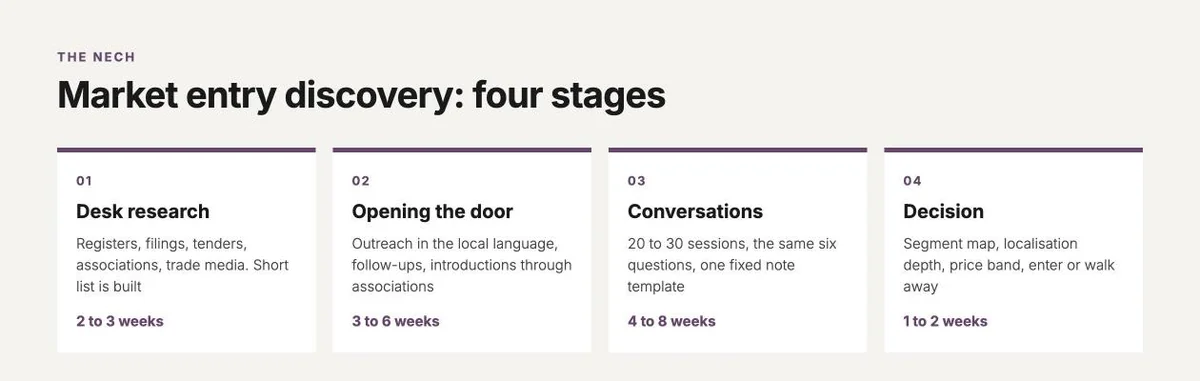
| Stage | What happens | Typical duration |
|---|---|---|
| 1. Desk research and target list | Registers, filings, tenders, associations, media. Short list built | 2 to 3 weeks |
| 2. Opening the door | Outreach in the local language, follow-ups, introductions through associations | 3 to 6 weeks, overlapping |
| 3. Structured conversations | 20 to 30 sessions, same six questions, notes against a fixed template | 4 to 8 weeks, overlapping |
| 4. Analysis and repositioning | Patterns, segment map, localisation depth, price band, go or no-go | 1 to 2 weeks |
August and late December are dead weeks across most of the EU. A discovery phase started in mid-July is a discovery phase that finishes in October. This is worth saying out loud before the timeline is promised to a board.
What does a discovery phase deliver?
The main deliverable is the exact degree of localisation required. Your product, service or technology rarely fits a new market in its raw form. The question is whether you need a change of vocabulary, a change of commercial terms, or a change to the offer itself.
| Level | What changes | Effort |
|---|---|---|
| Message | Vocabulary, proof points, references, case studies, the problem you lead with | Weeks |
| Commercial | Price band, payment terms, contract structure, warranty, channel and margin split | One to two quarters |
| Structural | Product specification, certification, local service model, legal entity, local stock | Quarters to years |
Most companies enter discovery assuming they are at the message level and leave knowing they are at the commercial level. That is a good outcome. It is far cheaper to learn it in week eight than in month fourteen, after a hire and a marketing budget. Where the answer is structural, the finding usually reshapes the wider market expansion strategy rather than the campaign.
When should you walk away from a market?
When the conversations show that the economics cannot work at your cost base. A transparent market entry analysis can end with the finding that the market does not fit your business right now. That is a result, not a failure, and it is the cheapest result discovery can produce.
The signals that point to walking away are consistent:
- The niche is hyper-segmented, and each segment is too small to carry the cost of serving it.
- Incumbents are entrenched with local service and framework agreements that renew before you can bid.
- Price competition sits below your marginal cost, and buyers treat the category as interchangeable.
- Qualification rules exclude you in practice: local certification, local stock, response time in hours, references from that country.
- Nobody is willing to be the first reference customer, in twenty conversations, at any price.
Discovering that in month two saves a company from a costly two-year detour. It also does something less obvious: it usually surfaces the adjacent market where the same offer does fit, because the same conversations reveal where the constraint disappears.
What are the most common mistakes?
Five mistakes account for most failed discovery phases. All five come from treating discovery as research rather than as a decision process with a deadline.
- Pitching instead of asking. The moment the conversation becomes a sales call, the honest answers stop. Fix: no price list, no deck, no offer in the first conversation.
- Talking only to friendly contacts. Existing partners and diaspora contacts are the easiest to reach and the least representative. Fix: at least half the list must be cold and local.
- Unstructured notes. Twenty conversations without a fixed template produce twenty stories that cannot be compared. Fix: the same six questions, recorded against the same fields.
- No decision criteria set in advance. Without a written go or no-go threshold, discovery drifts into permanent research. Fix: agree the threshold before the first call.
- Running it in the wrong language. English works at the level of the export director and stops at the level of the plant. Fix: run outreach and conversations in the local language wherever the buyer sits below the board.
Which markets do we run discovery in?
We work from Warsaw, in Polish, English and Ukrainian, and we run discovery in both directions: foreign companies entering the EU through Poland and Ukraine, and Polish and Ukrainian companies expanding into the wider EU, the United States, Canada and the Middle East.
If Poland is the market on the table, our Poland market entry page sets out the full sequence, from first conversations to first contracts, and the article on first B2B clients in Poland covers what happens immediately after discovery. For companies weighing both Poland and Ukraine, we cover the dual-market route separately. For the North American direction we have written up the Canada and Poland trade corridor in detail, and where discovery leads to a repositioning rather than a campaign, that work sits inside business strategy.
Questions we get asked
Is a discovery phase the same as market research?
No. Market research describes the market. A discovery phase tests whether your specific offer has a place in it, using conversations with the people who would have to buy it. The output of research is a document. The output of discovery is a decision and a localisation plan.
Can we run discovery ourselves?
Yes, if you have someone who can run outreach in the local language, has a reason for a stranger to reply, and can hold twenty to thirty structured conversations without turning them into sales calls. The failure mode is almost never analysis. It is the door not opening.
What does a discovery phase cost?
It is scoped by the number of segments and languages, not by the number of pages produced. The useful comparison is not the fee. It is the cost of one year of the alternative: a local entity, a first hire and a marketing budget aimed at a buyer profile that turns out to be wrong.
What if the conclusion is not to enter?
That is a valid and frequent outcome, and it is the reason the phase exists. In most cases the same twenty conversations also identify the adjacent segment or neighbouring market where the offer does fit, so the work is rarely a dead end.
How soon after discovery can the first contract land?
In B2B sectors with procurement cycles, the first contract typically follows six to eighteen months after discovery closes. Discovery shortens that window by removing the wrong segments, but it does not remove the buyer’s own budget calendar.
Sources, checked 3 September 2026
- Eurostat, International trade in goods by enterprise characteristics, 2024 data: SMEs accounted for 97.1% of enterprises exporting inside the EU and 39.4% of intra-EU export value; 95.2% of extra-EU exporters and 28.6% of extra-EU export value.
- Statistics Poland (GUS), monthly information on entities in the REGON register, end of January 2026: 5,443.6 thousand registered entities.
Want to test whether your assumptions about a market hold?
Book a first conversation. It is free, and thirty minutes is usually enough to establish whether there is a case worth building.
Book a consultation
Dima V. Nechyporenko is the founder of the nech, a Warsaw-based B2B advisory firm. He works with companies entering Poland and Ukraine, and with Polish and Ukrainian companies expanding into the EU, the United States, Canada and the Middle East. More about the team on the about us page.
Contact: contact form · LinkedIn