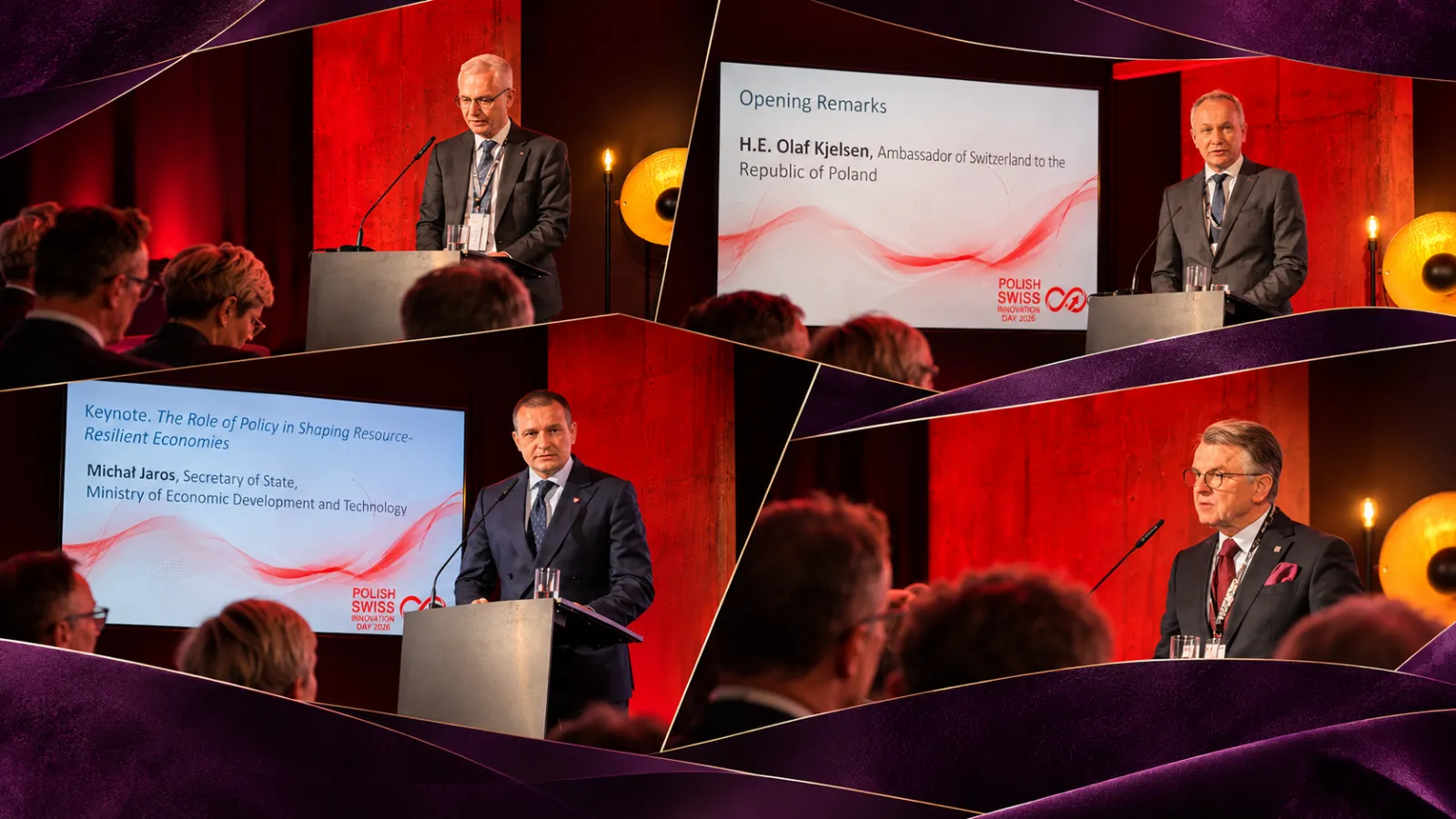
Top left: H.E. Olaf Kjelsen, Ambassador of Switzerland to Poland. Top right: Stanisław Tański, Board Member, Polish-Swiss Chamber of Commerce. Bottom left: Michał Jaros, Secretary of State, Ministry of Economic Development and Technology.
Polish Swiss Innovation Day 2026: circular economy as a business case, not a cost
Our founder, Dima V. Nechyporenko, attended the 11th Polish-Swiss Innovation Day in Warsaw. The strongest message of the day was not about ecology. It was about margins, supply security and how Switzerland, a country with almost no raw materials of its own, builds competitiveness through an innovation ecosystem. And about what Poland, which does have resources, industry and talent, can gain by working with it.
Event: Polish-Swiss Innovation Day 2026, 11th edition
Theme: Rethinking Life Cycles. Circular and Regenerative Pathways to Future-Proof Industries
Date and venue: 1 October 2026, Centralny Dom Technologii, Krucza 50, Warsaw
Organisers: Embassy of Switzerland in Poland and the Polish-Swiss Chamber of Commerce
Honorary patronage: Ministry of Economic Development and Technology, Ministry of Development Funds and Regional Policy, NCBR, Innosuisse
What is Polish-Swiss Innovation Day?
Polish-Swiss Innovation Day is a non-commercial conference series that the Embassy of Switzerland and the Polish-Swiss Chamber of Commerce have run since 2015. Every year it takes one topic and brings together business, science and the public sector from both countries. Previous editions covered sustainable mobility, cleantech, sustainable buildings, AI in manufacturing and, in 2025, the industry of the future.
The 2026 edition focused on circular and regenerative models across agriculture, construction, manufacturing, energy and digital infrastructure. The organisers framed it with two numbers worth remembering: roughly 10% of Swiss companies already run business models substantially based on circular principles, and under the Swiss-Polish Cooperation Programme Switzerland is committing over CHF 320 million until 2029 to urban development and to research and innovation in Poland, both linked to the circular economy.
Who opened Polish-Swiss Innovation Day 2026 and what set the tone?
The conference was opened by representatives of both organisers, followed by a keynote from the Polish government. Together, the three speeches framed the day: circularity as a matter of competitiveness, not only of environmental policy.
H.E. Olaf Kjelsen, Ambassador of Switzerland to Poland
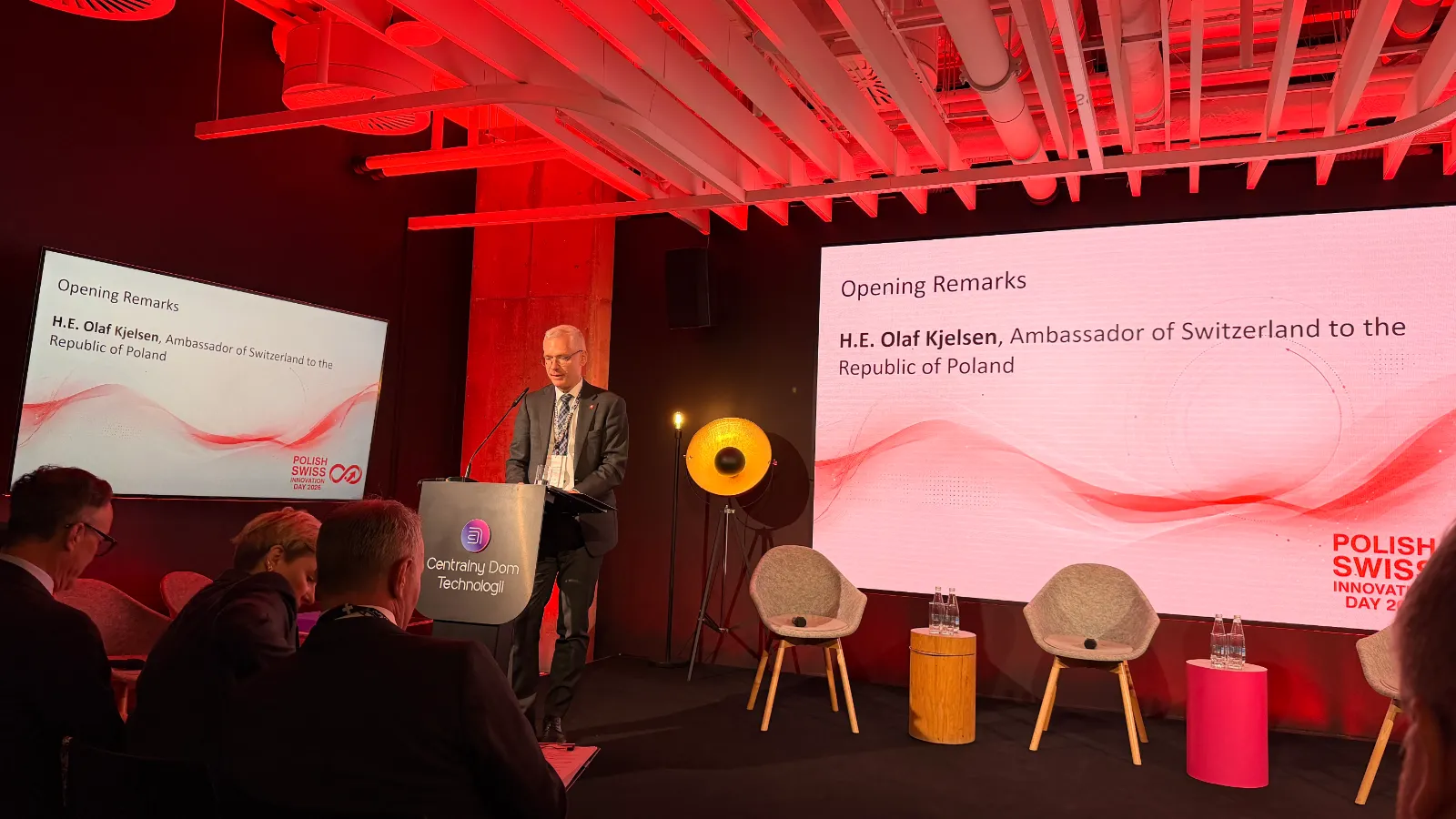
Ambassador Kjelsen opened the day on behalf of the Embassy of Switzerland. He is an electrical engineer by training, a graduate of ETH Zurich, and a career diplomat with the Swiss Federal Department of Foreign Affairs since 1994. He was appointed Ambassador to Poland in October 2025, after postings including Ambassador to Greece and to Canada. He knows Poland well: earlier in his career he served as Deputy Head of Mission at the Swiss Embassy in Warsaw, and he has worked extensively on economic relations and cross-border cooperation. His opening placed the conference in the wider context of Swiss-Polish cooperation, including the Swiss-Polish Cooperation Programme, under which Switzerland is committing over CHF 320 million until 2029 to urban development and to research and innovation in Poland.
Stanisław Tański, Board Member, Polish-Swiss Chamber of Commerce
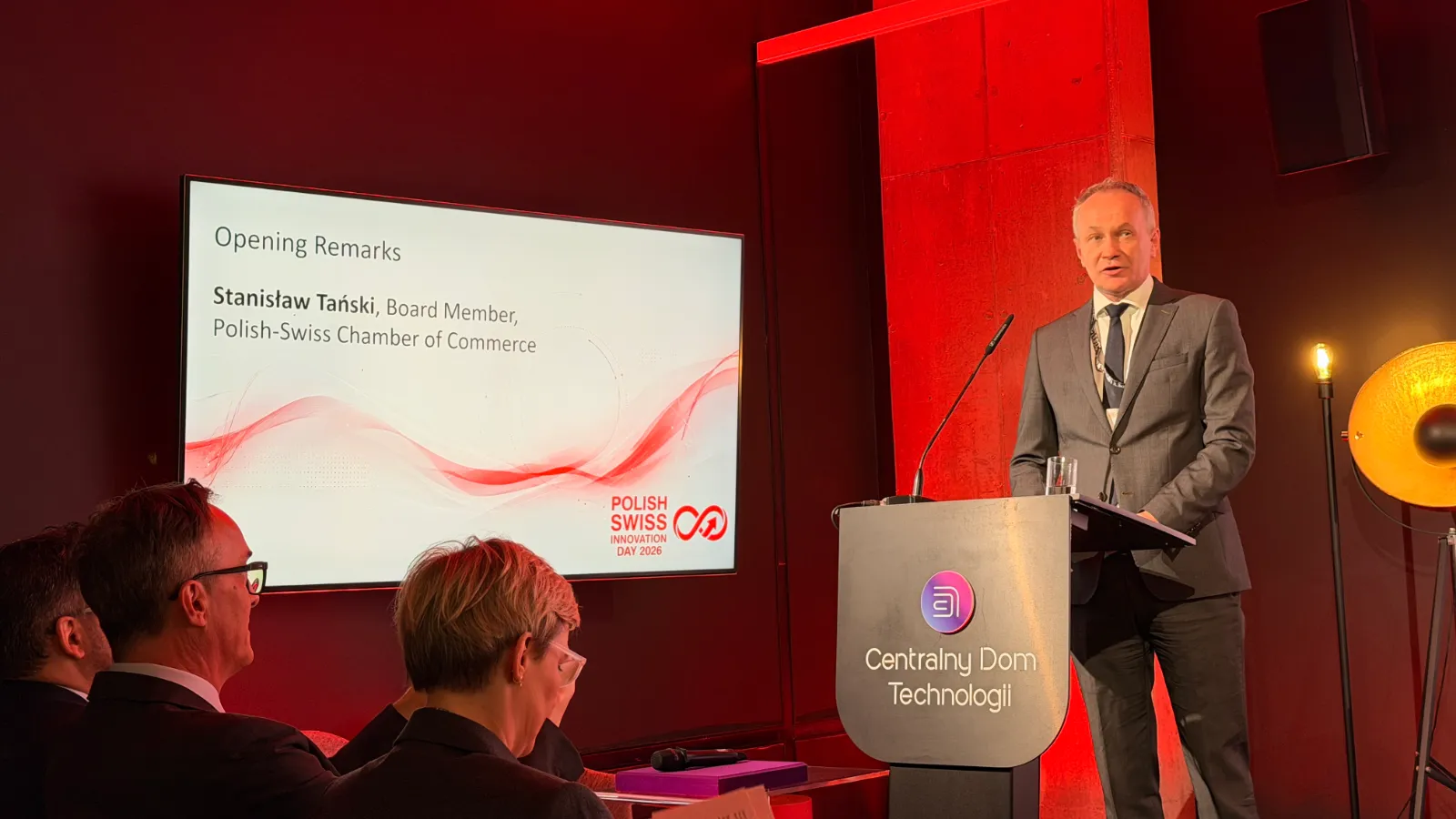
Stanisław Tański spoke on behalf of the Polish-Swiss Chamber of Commerce, co-organiser of the event. Outside the Chamber, he is President of the Management Board of ABB in Poland, where he has worked since 2006 in finance and business leadership roles before becoming Country Holding Officer in 2022. His focus is technology, innovation and leadership, and in particular strategic transformation that strengthens a company’s resilience and competitiveness. That business perspective is exactly what the Chamber brings to the event: a network of around 230 member companies, most of them Swiss businesses operating in Poland, for whom circularity is an operational question, not an abstract one.
Michał Jaros, Secretary of State, Ministry of Economic Development and Technology
The keynote, “The Role of Policy in Shaping Resource-Resilient Economies”, was delivered by Michał Jaros, Secretary of State at the Ministry of Economic Development and Technology, which also held honorary patronage over the conference. An economist by education (University of Economics in Wrocław) and a Member of the Sejm for the Wrocław constituency since 2007, he presented the perspective of the Polish state. Poland treats the circular economy as a strategic tool: a way to strengthen industrial competitiveness, reduce dependence on imported raw materials and support the green transformation of the economy. The role of policy, in this view, is to create the conditions in which companies can turn circular models into business, which is the same question that business speakers would come back to throughout the day.
Why does Switzerland treat the circular economy as a business strategy?
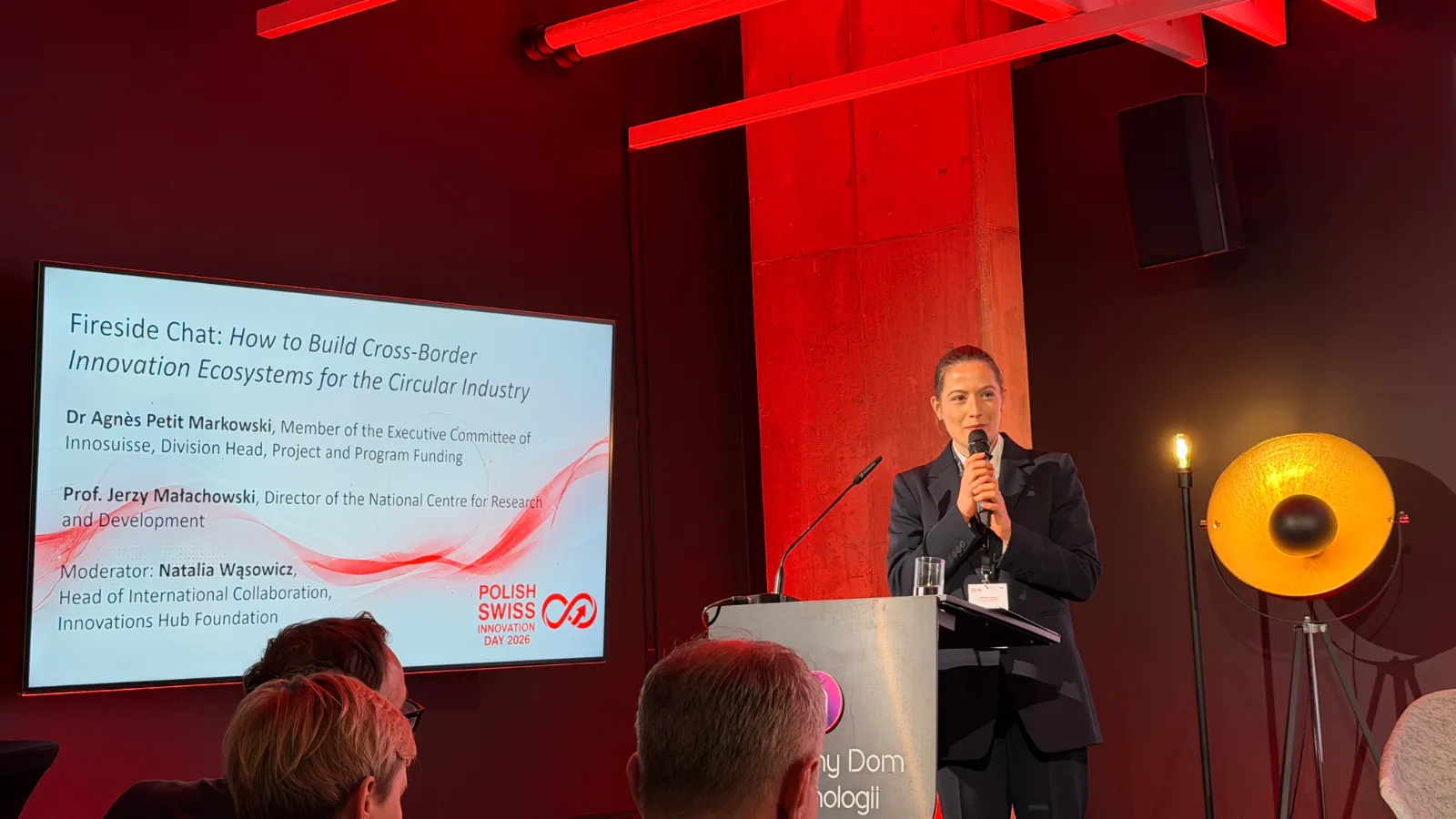
The fireside chat on cross-border innovation ecosystems, with Dr Agnès Petit Markowski of Innosuisse and Prof. Jerzy Małachowski, Director of the National Centre for Research and Development (NCBR), moderated by Natalia Wąsowicz of Innovations Hub Foundation, set the tone for the day.
Dr Petit Markowski, who built her career in the construction materials industry and founded her own construction-tech startup before joining Innosuisse, made a point we rarely hear this clearly: in Switzerland the circular economy is not driven by ecology first. It is driven by business results, with EBITDA as the deciding argument. She noted that most raw materials used by the Swiss economy are imported (she cited around 70%). Independent data points the same way: the Circularity Gap Report Switzerland estimates that only about one tenth of Swiss material demand is covered by domestic extraction, and fossil fuels and metal ores are imported entirely. That turns resource efficiency into a question of cost and supply risk rather than reputation.
It is worth keeping the scale in perspective. According to the Swiss Federal Office for the Environment (BAFU), around 10% of Swiss companies are currently active in the circular economy to a substantial degree, and recycled materials still cover only about 14% of total material consumption. Construction, the industry Dr Petit Markowski knows best, is one of the sectors where this shift is most visible. In other words, Switzerland is not “already circular”. It is a country that has decided circularity is a competitive necessity and is building the system to get there.
When resources are expensive and imported, using them twice is not a green gesture. It is a margin decision.
The system behind this does not appear by accident. Switzerland invested CHF 25.9 billion in research and development in 2023, around 3.2% of GDP and well above the EU average of about 2.2%. Business enterprises carry out roughly 69% of all R&D activity, and around 150,000 people work in R&D. That money flows through a deliberately built ecosystem:
- universities and an education system that produce applied engineers, not only researchers;
- an R&D base that turns research into products companies can sell;
- public institutions such as Innosuisse that connect business and the state and build trust between them;
- financial institutions willing to back new ideas;
- private companies that define what they actually need to grow at home and in international markets.
How do Swiss companies use Poland’s research and engineering base?
This was the part of the discussion most relevant to our clients. The Swiss ecosystem does not stop at the border. Dr Petit Markowski described how, at one of the companies she worked for, around 10% of the R&D engineering team came from Poland. That was not a coincidence: it was the result of long-term cooperation with Polish universities.
The model works both ways. Swiss companies gain access to Polish scientific talent and research capacity, while Polish partners gain Swiss innovation experience, commercialisation know-how and access to international supply chains. Prof. Małachowski’s NCBR is one of the institutions that makes this kind of cooperation fundable on the Polish side.
Why is the active exchange between Poland and Switzerland so important?
Because it is already a large, working economic relationship, and it is still growing. According to the Swiss Federal Department of Foreign Affairs, Poland is Switzerland’s most important export market in Central Europe, with bilateral trade of just under CHF 6.5 billion in 2025 (excluding gold). Switzerland is the tenth-largest foreign investor in Poland, with more than CHF 7.5 billion invested, and Swiss companies account for over 95,000 jobs in the country. The Polish-Swiss Chamber of Commerce, founded in 1998, brings together around 230 member companies, including most Swiss businesses operating in Poland.
What made the strongest impression on us, however, was not the numbers. It was the entrepreneurial spirit on both sides of the room. Swiss speakers talked about circularity in the language of founders and CFOs: payback, margins, new revenue. Several of them had built companies themselves. Polish companies, in turn, showed how far a local business can go when it combines engineering talent with ambition: DCX, a Polish manufacturer of liquid cooling systems, now ships to 75 countries. This is the kind of exchange that moves economies forward: Swiss experience in commercialising innovation meets Polish speed, engineering capacity and hunger for growth.
In a period of economic and security pressure in Europe, that exchange is not a diplomatic nicety. It makes both economies more resilient, more modern and more competitive, and it opens concrete doors for companies that know how to use it.
For a foreign company looking at Poland, this is a strong argument that goes beyond labour cost. Poland is increasingly a place to build engineering and R&D capability, not only production. This is exactly the conversation we have with companies during Polish market entry projects.
How can Poland grow its economy in cooperation with Switzerland? Five keys
To be clear about the starting point: the resource problem is Swiss, not Polish. Poland has what Switzerland lacks. Forests cover almost 30% of the country and the volume of wood keeps growing, there is a large industrial base, one of the most extensive district heating systems in the EU, land for new energy and data infrastructure, and a deep pool of engineers. Switzerland brings what Poland needs to turn those assets into higher value: technology, experience in commercialising innovation, patient capital and access to demanding international customers. From what we heard at the conference, the cooperation works best along five lines.
- Polish resources, Swiss efficiency. SWISS KRONO in Żary is a good example: a Swiss group processing Polish wood in Poland, and pushing for the cascade model so that more value stays in the industry instead of going up the chimney. The same logic applies to secondary raw materials, construction materials and water.
- Joint R&D with public co-funding. NCBR on the Polish side and Innosuisse on the Swiss side already run joint calls for Swiss-Polish projects, and the Swiss-Polish Cooperation Programme adds over CHF 320 million until 2029 for research, innovation and urban development. For companies, this lowers the cost and risk of developing new products together.
- Polish suppliers in Swiss value chains. More than 95,000 people in Poland already work for Swiss companies. The next step is moving from production to engineering, design and R&D, which is exactly what the 10% of Polish engineers in a Swiss R&D team shows.
- Energy and digital infrastructure. Polish technology such as DCX liquid cooling, Polish district heating networks and Swiss know-how in efficiency create a natural match for data centres and industrial heat reuse.
- Institutions that open doors. The Polish-Swiss Chamber of Commerce, the Swiss Business Hub, the embassy and events like Polish-Swiss Innovation Day are where partnerships start. Companies that use them deliberately move faster than those that wait to be found.
In short, Poland does not need the Swiss model because it lacks resources. It needs it to get more value out of the resources it has.
What did Geberit and Swiss Krono show about using resources differently?
Geberit: water efficiency as a product feature
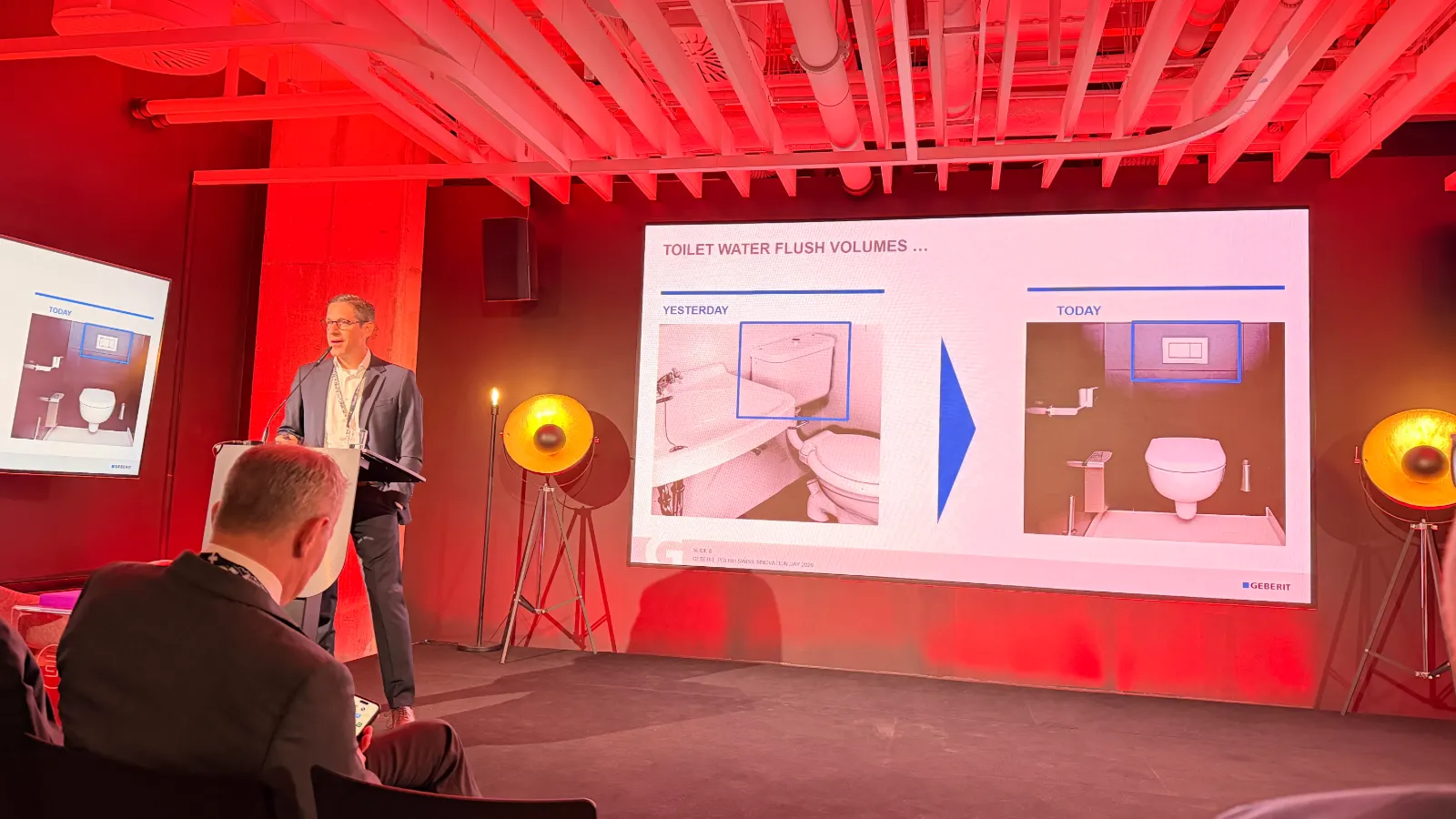
Mark Schneider, Head of Sustainability at Geberit Group, showed how the company treats water efficiency in use as its main circular contribution. In 1952 a toilet flush used around 14 litres of water. Today dual-flush systems need 4 or 2.6 litres. According to Geberit, an 80% reduction in flush volume per person per day is technically possible compared with 1952, and the company sees further room to go. The lesson for any manufacturer: the most valuable circular gains often sit in how the customer uses the product, and that becomes a selling point.
Swiss Krono: wood is too valuable to burn
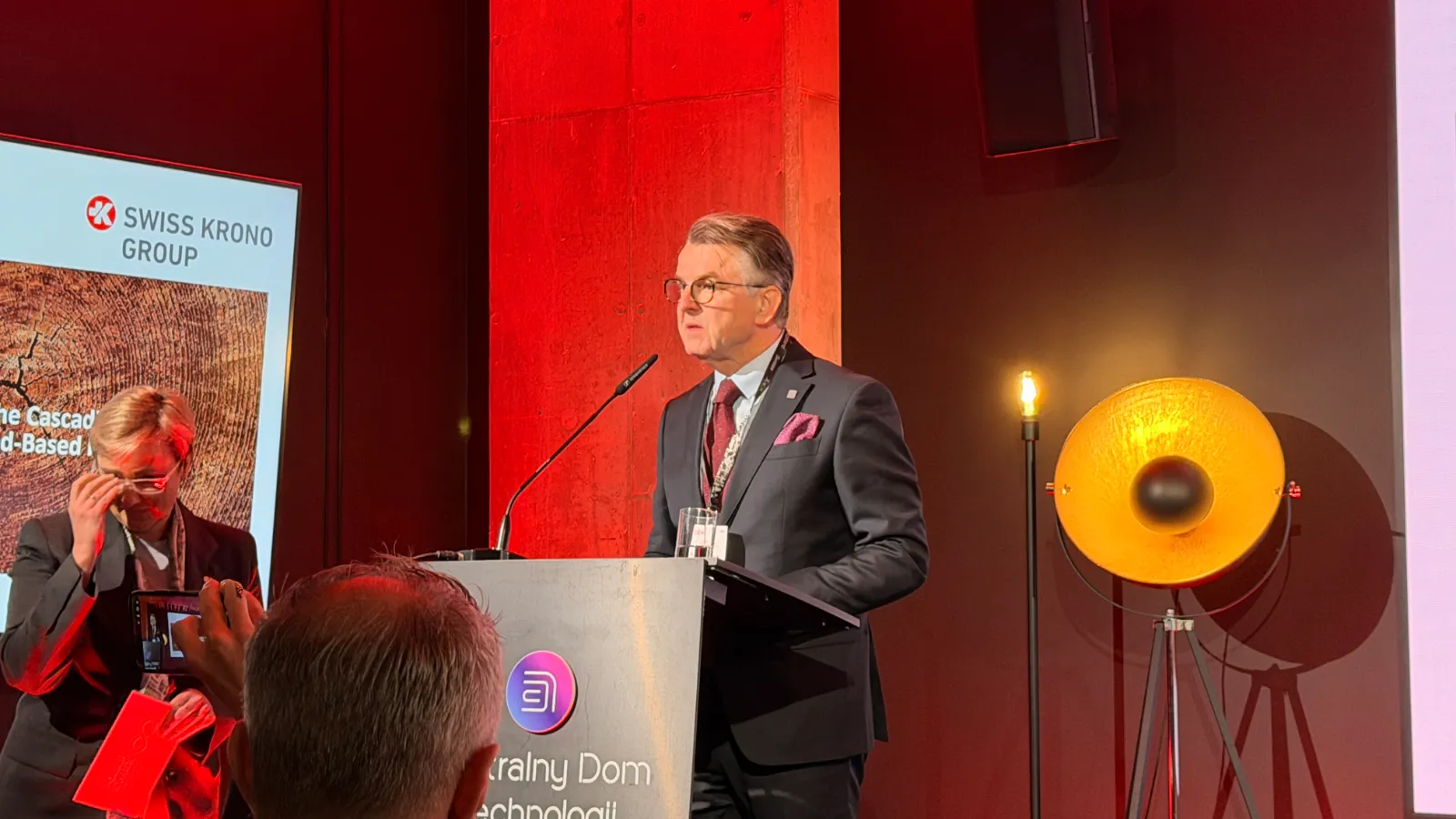
Dr Eng. Jędrzej Kasprzak, Head of Wood Procurement at SWISS KRONO in Żary, presented the cascade use of wood in the production of wood-based panels. Some of the data from his presentation, based on State Forests and GUS figures:
- forest cover in Poland grew from 20.8% in 1946 to 29.6% in 2023, with 33% projected for 2050;
- the growing stock is around 2.72 billion m³, with an annual increment of about 66 million m³ and a harvest of about 41 million m³, so roughly 62% of the annual increment is harvested;
- the average age of Polish forests rose from 49 years in 1978 to 64 years in 2022.
The core argument: approximately half of the wood in Europe is burned. In a cascade model, wood goes first to sawmilling, furniture and panels, then to reuse, then to recycling into panels and pulp, and only at the very end to energy recovery. His main conclusions were sharp. The wood and furniture industry is strategic for Poland but has weak political representation. Raw material availability is a real problem because harvesting in the State Forests has been reduced despite large timber resources. The energy sector competes with industry for valuable wood. And Poland is not yet using the potential of post-consumer wood recycling, because clear regulations, waste wood classification and effective separate collection are missing. Post-consumer wood, in his view, is becoming a strategic new feedstock.
How are AI, data centres and the circular economy connected?
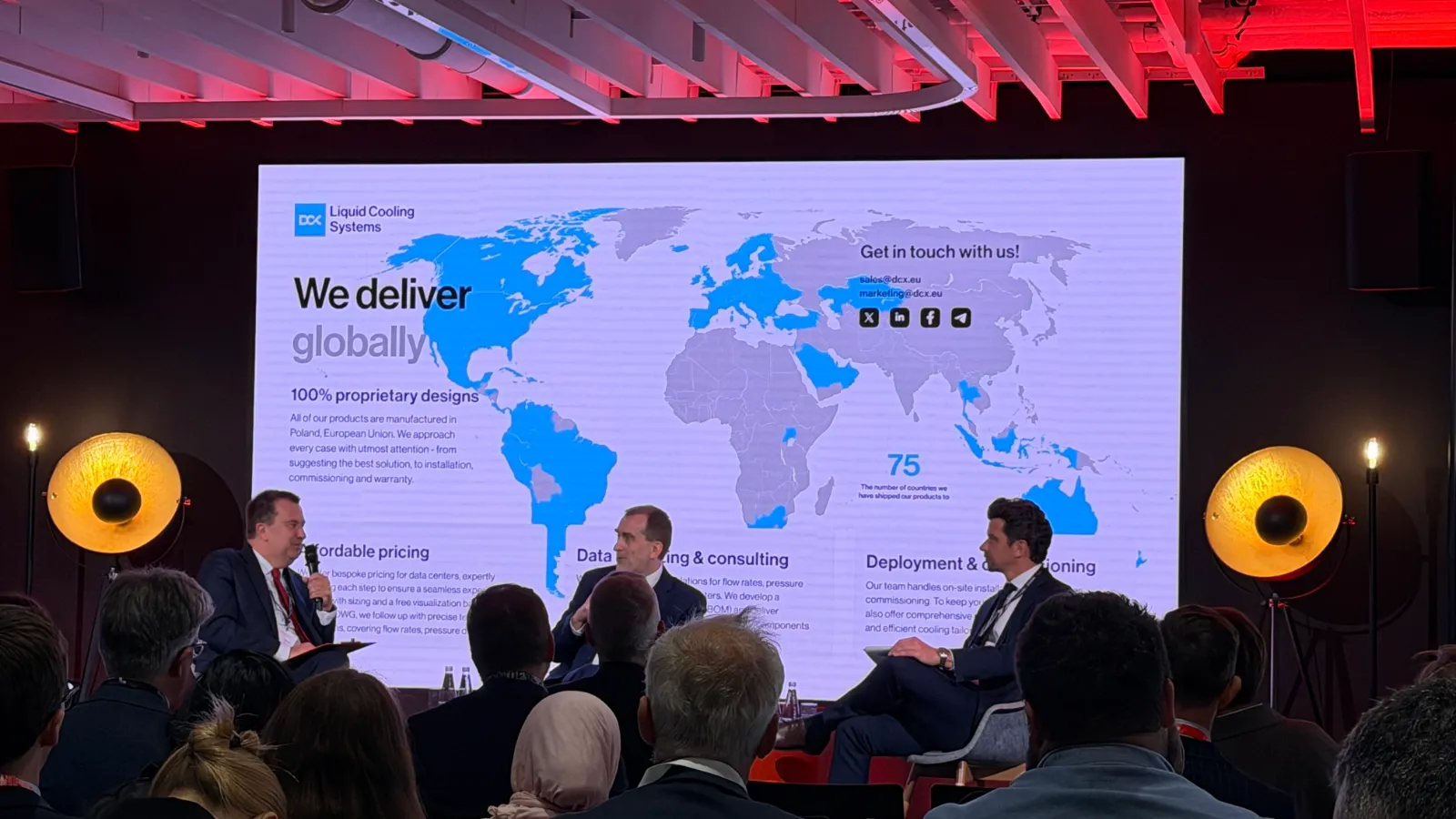
The fireside chat “From data to action” brought together Tomasz Buk, CEO of DCX Liquid Cooling Systems, and Mariusz Słomski, Marketing Director of Endress+Hauser Polska, moderated by Łukasz Korycki, Deputy Editor-in-Chief of Puls Biznesu.
DCX is a good example of what a Polish technology company can achieve: its liquid cooling products are designed and manufactured in Poland and have been shipped to 75 countries. A few points from the discussion stood out:
- Energy is the core constraint for data centres, and data centres are the physical heart of AI. Power availability and grid connection increasingly decide where new capacity is built in Europe. Greece was mentioned as one of the markets attracting new projects, and it is: Microsoft, AWS and Google have all announced investments there, and the utility PPC is planning a 300 MW campus on a former lignite site. At the same time, analysts point out that grid capacity is the main bottleneck even there, which only confirms the point: whoever has power, has data centres.
- Closed-loop liquid cooling does not evaporate water. In direct-to-chip systems the cooling loop is filled once and then recirculates, so ongoing water use for cooling the chips is close to zero. This is why new AI data centres from operators such as Microsoft and Oracle are moving to this design. The heat still has to be rejected somewhere, which leads to the next point.
- Waste heat is a resource. Heat recovered from data centres can feed district heating or any process that needs hot water, a textbook circular use of energy. It is already happening: in Finland, Fortum has started operating heat pump plants at Microsoft data centre sites, and once the data centres are fully running, their waste heat is expected to cover around 40% of district heating demand for about 250,000 residents of Espoo and Kirkkonummi. Under the EU Energy Efficiency Directive, data centres above 1 MW must now assess and, where feasible, use their waste heat. For Poland, where district heating networks are among the most extensive in the EU, this is a real opportunity.
- AI cannot tell good data from bad. If data is the new oil, it has to be collected and processed properly, which puts measurement and instrumentation, Endress+Hauser’s field, at the start of the value chain.
From our perspective this is where energy and digital infrastructure meet. Dima V. Nechyporenko spent over 18 years in energy-sector strategy and business development, including utility-scale solar, battery storage and grid projects across Europe. Questions like grid capacity, heat reuse and energy cost per unit of output are now becoming board-level questions for data centre and industrial investors in Poland.
The programme continued with a fireside chat on regenerative agriculture with Dr Agata Kruszec of Nestlé Polska and Alex von Hettlingen of Regenerativ Schweiz, and a closing panel on opportunities and challenges for circular industry with representatives of the Ministry of Economic Development and Technology, EcoBean, Wrocław University of Environmental and Life Sciences and Holcim Polska.
Is the circular economy just a regulatory requirement and a cost, or a strategic necessity?
This was the central question of the day, and it was asked openly: is circularity something companies do because they have to, or because it makes them stronger? And is it sustainable from a business point of view, not only an environmental one?
The honest answer is that it is both a requirement and a strategy, and companies that treat it only as the first will pay for it twice.
Why it is becoming a requirement anyway
Regulation is arriving from every direction. In 2024 the Swiss parliament adopted amendments that anchor the circular economy in its environmental, energy and public procurement laws, and the first implementing changes to the waste ordinance have applied since 1 August 2026, with a new packaging ordinance due in 2027. In the EU, data centres already have to report on energy and waste heat, sustainability reporting is expanding along supply chains, and large buyers pass these requirements down to their suppliers. A Polish manufacturer selling to a Swiss or German group will be asked about material efficiency and recycled content whether it plans for it or not.
Why it is a strategic necessity
The business case discussed at the conference rests on four arguments:
- Cost of inputs. Every tonne of material used twice is a tonne not bought at market price. This is why Swiss speakers framed circularity through EBITDA, not ESG ratings.
- Security of supply. Swiss Krono showed it clearly: when industry and the energy sector compete for the same wood, the company that can use post-consumer wood has a feedstock its competitors do not.
- Product value for the customer. Geberit does not sell “circularity”. It sells toilets that use 80% less water per person per day than in 1952. The customer pays for lower bills, and the environmental gain comes with it.
- New revenue streams. Waste heat from a data centre can be sold to a heating network. Wood residues become panels. What was a disposal cost becomes a product.
Where it stays only a cost
It would be dishonest to say circularity always pays. Research by ETH Zurich and the Swiss environment office found that consumers support the idea but are rarely willing to pay more for repairability or recyclability; price and service life still decide. Circular projects with long payback periods, no buyer for the secondary material or no link to the core product often stay a cost line.
So our practical test is simple. A circular initiative is sustainable for the business when it does at least one of three things: lowers the cost of inputs, secures access to a critical resource, or creates something a customer will pay for. When the circular economy sits only in the sustainability or compliance department, it is a cost: reports, certificates and client questionnaires. When it sits with the CEO, CFO and sales, it becomes a source of margin. Geberit sells water savings, Swiss Krono turns post-consumer wood into feedstock, DCX sells cooling that wastes no water and makes heat reuse possible. In each case the circular logic is part of the commercial offer, not a report about it.
What does this mean for companies in Poland and those entering it?
Three practical conclusions for the SMEs and international companies we work with:
- Circularity is becoming a procurement criterion. Large Swiss and Western European buyers increasingly ask suppliers about material efficiency and recycled content. Polish suppliers who can answer with numbers win tenders.
- Poland is a partner market, not only a production base. The Swiss model shows that the R&D, engineering and university cooperation available in Poland is a strategic asset for foreign companies.
- Cross-border ecosystems are built through relationships. Chambers of commerce, embassies, funding agencies such as NCBR and Innosuisse, and events like this one are where those relationships start. A company entering a new market needs a plan for how to use them, not just a sales target.
If you are looking for Polish partners, suppliers or distributors, our partner sourcing service is built for exactly that. If you are planning to scale beyond Poland, start with a market expansion strategy.
We would like to thank the Polish-Swiss Chamber of Commerce and the Embassy of Switzerland in Poland for a high-quality event with strong case studies and excellent speakers. It was a clear example of how modern economies can and should be built.
About the author
Dima V. Nechyporenko is the founder of the nech, a Warsaw-based B2B consulting firm specialising in market entry, B2B sales development and international expansion. He has over 18 years of experience in strategy and business development in the energy sector across Ukraine, the EU, Canada and the UAE, including EPC projects in solar, battery storage and grid infrastructure. He speaks at industry forums on distributed generation and market entry strategy. More about Dima as a speaker.